
A cash-out refinance isn't just a new loan; it's a way to tap into the wealth you've built in your home. It replaces your current mortgage with a new, larger loan, and you get the difference in cash. Homeowners often use this strategy to fund big projects, consolidate debt, or cover major life expenses.
How a Cash-Out Refinance Unlocks Your Home Equity

Think of your home's equity as a piggy bank. Every mortgage payment you make is like dropping a coin in the slot. At the same time, if your home's value goes up, it’s like someone else is adding money to it for you. A cash-out refinance is simply a way to access that stored-up value.
The process is straightforward: you apply for a new mortgage that’s bigger than what you currently owe. The new loan pays off your old one entirely, and the leftover cash—minus any closing costs—is yours to keep.
The Core Concept Explained
Let's walk through a real-world example. Say your home is appraised at $500,000, and your remaining mortgage balance is $250,000. That leaves you with $250,000 in home equity. Before diving deeper, it's worth getting a solid grasp of what real estate equity is because it's the foundation of this entire process.
Most lenders will let you borrow up to 80% of your home's value. This is called the loan-to-value (LTV) ratio, a key metric in the lending world. You can learn more about how lenders use the loan-to-value ratio in our detailed article. In our scenario, 80% of your $500,000 home value is $400,000.
A cash-out refinance doesn't add a second loan on top of your existing one. It’s a full replacement, giving you a single, new mortgage and just one monthly payment to manage.
Here’s a quick breakdown of the math:
- New Loan Amount: $400,000 (This is the 80% LTV)
- Payoff Old Mortgage: -$250,000 (Your old loan is wiped out)
- Cash to You (before costs): $150,000 (This is the cash you walk away with)
Once everything is settled at closing, you'd get up to $150,000 in cash. Your new mortgage balance would be $400,000, and you’d start making payments on that new loan term.
Why Homeowners Choose This Path
People decide to do a cash-out refinance for all sorts of reasons—the flexibility of the cash is a major draw. It’s a powerful tool for tackling big financial goals.
Some of the most common uses include:
- Major Home Renovations: That dream kitchen remodel, a much-needed bathroom addition, or a new home office can be funded this way, often increasing your property's value in the process.
- Debt Consolidation: High-interest debt from credit cards or personal loans can be overwhelming. Rolling it all into a single mortgage payment, usually at a much lower interest rate, can provide significant financial relief.
- Significant Investments: Some use the funds for college tuition, to launch a new business, or even to make a down payment on an investment property.
- Life Events: Big moments like a wedding or funding extended travel can be made possible. It can also provide a solid emergency fund for peace of mind.
By turning your illiquid home equity into usable cash, you open up a world of financial possibilities. A trusted partner like Mortgage Seven LLC can help you run the numbers for your specific situation, making sure you understand all the details and feel confident in your decision.
Weighing the Pros and Cons of Cashing Out Your Equity

Tapping into your home's equity with a cash out refinance mortgage is a major financial decision. It’s a move that can open up incredible opportunities, but it also carries real responsibility. Before you even think about signing on the dotted line, you need a clear-eyed view of both the good and the bad.
This isn't just about getting quick cash; it's about making a strategic choice that benefits your long-term financial health. Let's break down the advantages and disadvantages so you can figure out if it's the right path for you.
Key Advantages of a Cash Out Refinance
One of the biggest draws is the interest rate. Think about it: mortgage rates are almost always lower than the rates on credit cards or personal loans. If you're carrying high-interest debt, rolling it all into a single, lower-rate mortgage payment can save you a ton of money every single month.
The flexibility is another huge perk. The cash you pull out is yours, plain and simple. There are no strings attached. You can use it to finally tackle that big kitchen remodel, pay for college tuition, or even get a small business off the ground.
For example, imagine using the cash to add a dedicated home office. Not only does this make your day-to-day life easier, but it can also boost your property's value down the road. It’s an investment in your biggest asset.
Plus, it just makes life simpler. Instead of juggling a handful of different payments for credit cards, a car loan, and other debts, you combine them all. One single mortgage payment is much easier to manage and budget for, reducing a lot of financial stress.
Potential Disadvantages to Consider
Now for the other side of the coin. While the benefits sound great, the drawbacks demand serious thought. First and foremost, you’re putting your home on the line. Because your house is the collateral, missing payments puts you at risk of foreclosure. This is the single most important factor to consider.
Closing costs are also a part of the deal. Just like when you first bought your home, a cash-out refi comes with fees for the appraisal, title search, origination, and more. These costs usually run between 2% to 5% of your new loan amount, which can easily add up to thousands of dollars.
You’re also resetting your mortgage clock. Let's say you’re ten years into a 30-year loan. If you refinance into a new 30-year loan, you're now on the hook for payments for a total of 40 years. Your monthly payment might drop, but you could pay way more in total interest over the life of the loan.
It’s also crucial to remember that if your new loan is for more than 80% of your home's value, you'll likely have to pay for private mortgage insurance (PMI). You can learn more about private mortgage insurance to see how it might affect your costs.
To help you see it all at a glance, here’s a straightforward comparison.
Pros vs Cons of a Cash Out Refinance
| Key Advantages (Pros) | Potential Disadvantages (Cons) |
|---|---|
| Lower Interest Rates: Typically better than credit cards or personal loans. | Home is Collateral: Defaulting on payments could lead to foreclosure. |
| Flexible Funds: Use the cash for any purpose you choose. | Closing Costs: Expect to pay 2% to 5% of the loan amount in fees. |
| Debt Consolidation: Combine multiple debts into one simpler payment. | Resets the Loan Term: Starts a new 30-year clock, potentially increasing total interest paid. |
| Potential Tax Benefits: Mortgage interest may be tax-deductible (consult a tax advisor). | Higher Loan Balance: You owe more on your home than you did before. |
| Fixed Payments: Provides a predictable and stable monthly payment. | Potential for PMI: Required if your loan-to-value ratio exceeds 80%. |
Ultimately, a cash out refinance mortgage is a powerful tool when used wisely. It makes the most sense when you’re using the money to improve your financial position—like wiping out high-interest debt—or to increase your home’s value. By carefully weighing these pros and cons, you can make a smart, informed decision that truly works for you.
Meeting the Lender Requirements for a Cash Out Refinance
Getting approved for a cash-out refinance isn’t about hitting one magic number. It's about showing the lender a complete and stable financial picture. I like to think of it as a three-legged stool: if one leg is wobbly, the whole thing feels risky. Lenders are looking at three main pillars to decide if you're a good candidate: your credit score, your debt-to-income ratio (DTI), and the amount of equity you have, which is measured by the loan-to-value ratio (LTV).
A strong application tells a clear story: you're a reliable borrower who can comfortably handle the new, slightly larger mortgage payment. When you understand what lenders are looking for ahead of time, you can put your best foot forward and fix any weak spots before you even apply.
The Three Pillars of Qualification
Lenders need to feel confident you can pay back the loan, and they use a few key data points to gauge that risk. Each of these pillars reveals a different piece of your financial story, and together they give the underwriting team the full picture they need.
- Credit Score: This is basically your financial report card. A higher score, usually 620 or better for a conventional cash-out refi, shows a history of responsible borrowing. It can also unlock much better interest rates.
- Debt-to-Income (DTI) Ratio: This simple calculation compares your total monthly debt payments (including the proposed new mortgage) to your gross monthly income. Most lenders want to see a DTI of 43% or lower. It’s their way of making sure you won't be stretched too thin.
- Loan-to-Value (LTV) Ratio: This one is all about how much of your home you truly own. Lenders typically cap cash-out refinances at an 80% LTV, which means you need to keep at least 20% equity in your home after the new loan is in place.
Interestingly, cash-out refinances help a really diverse group of homeowners. Recent studies have shown these loans are popular among older borrowers and are a crucial tool for women, Black, and Hispanic homeowners to access their equity, even if their credit or income profiles differ from those in a standard refinance. You can read the full report on cash out refinance borrowers for a closer look at these trends.
Calculating Your Borrowing Power
That 80% LTV rule is the single most important factor in figuring out how much cash you can actually pull out. The math is pretty straightforward and gives you a great starting point.
Let's run through an example:
- Your home’s appraised value: $500,000
- Your maximum new loan amount (80% of value): $400,000
- What you still owe on your current mortgage: $220,000
- Potential cash you can get (before closing costs): $180,000 ($400,000 – $220,000)
This calculation shows there's a good chunk of cash available. Just remember, the final amount also hinges on your credit and DTI hitting the lender's targets.
Assembling Your Documentation
Once you feel good about your numbers, it's time to gather your paperwork. Trust me, having everything organized and ready to go can make the whole underwriting process move so much faster. The lender’s job is to verify everything—your income, your assets, and your existing debts.
Here’s a quick checklist of what you’ll almost certainly need:
- Proof of Income: Your last 30 days of pay stubs and your W-2s from the past two years.
- Tax Returns: Two years of your complete federal tax returns, including all schedules. Don't leave anything out!
- Asset Statements: Recent statements from your checking, savings, retirement, and any investment accounts.
- Mortgage Statements: The most recent statement for your current home loan and any other properties you own.
- Identification: A clear copy of your driver’s license or another government-issued photo ID.
If your situation is a little different—say, you're self-employed—firms like Mortgage Seven LLC can help you explore other options, like using bank statements to prove income instead of W-2s. For a more detailed breakdown of the whole process, you can check out our guide on how to qualify for a refinance.
Comparing Cash Out Refinance Against Other Equity Options
A cash-out refinance is a powerful way to tap into your home's equity, but it’s not the only game in town. To make the smartest move, you need to understand how it stacks up against its main competitors: the Home Equity Loan (HEL) and the Home Equity Line of Credit (HELOC).
Here's a simple way to think about it. A cash-out refinance completely replaces and resets your primary mortgage. A Home Equity Loan is like adding a second, smaller mortgage on top of your existing one. And a HELOC? That’s basically a credit card backed by your house, giving you a flexible credit line to use as you wish.
The popularity of these options ebbs and flows with the economy. When interest rates hit rock bottom in late 2021, cash-out refinances exploded, peaking at nearly 730,000 in a single quarter. As rates climbed, those numbers tumbled, which just goes to show how much market conditions matter. You can see more data on cash-out refinance trends directly from the Consumer Financial Protection Bureau.
Cash Out Refinance vs. HELOC: The Lump Sum vs. The Credit Line
The most frequent showdown is between a cash-out refinance and a HELOC. The core difference is how you get your money. A cash-out refi hands you one big check at closing with a fixed interest rate. This makes it a fantastic fit for large, one-time expenses where you know the exact cost upfront—think a new roof or paying off a mountain of credit card debt.
A HELOC, on the other hand, gives you a revolving line of credit. You can borrow what you need, when you need it, up to your approved limit. This flexibility is perfect for projects with fuzzy timelines or ongoing costs, like a home renovation you plan to tackle in phases.
A key takeaway is that with a HELOC, you only pay interest on the amount you actually borrow. If you have a $50,000 credit line but only use $10,000, you're only charged interest on that $10,000.
This decision tree can help you visualize which path might be right for you based on your financial standing.
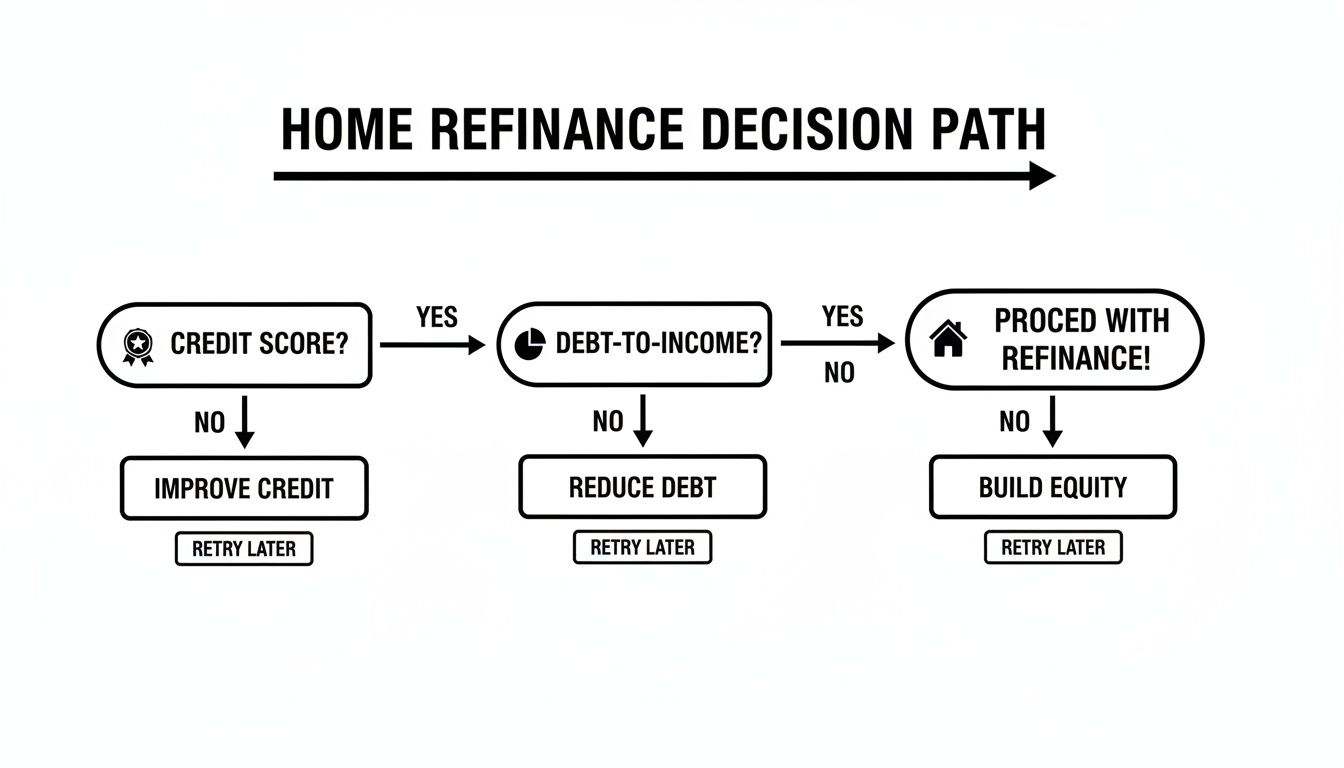
As the flowchart shows, basics like your credit score, debt-to-income ratio, and available equity are the starting line for any of these options.
Factoring in the Home Equity Loan
Don't forget about the Home Equity Loan (HEL), often called a "second mortgage." Just like a cash-out refinance, it gives you a lump sum of cash. The huge difference is that it doesn't touch your primary mortgage. It’s an entirely separate loan that runs alongside your first one, with its own monthly payment.
This is a brilliant move when you’ve locked in a ridiculously low interest rate on your current mortgage and don't want to let it go. Refinancing your entire loan would mean giving up that great rate. An HEL lets you keep it while still accessing the cash you need.
Comparing Home Equity Products: Cash Out Refinance vs. HELOC vs. Home Equity Loan
Choosing the right way to tap your home's equity can feel complicated, but it gets much clearer when you see the options side-by-side. This table breaks down the three primary methods to help you find the perfect match for your financial situation.
| Feature | Cash Out Refinance | Home Equity Line of Credit (HELOC) | Home Equity Loan |
|---|---|---|---|
| How You Get Funds | A single, large lump sum at closing. | A revolving line of credit you can draw from over time. | A single, large lump sum at closing. |
| Loan Structure | Replaces your current mortgage with a new, larger one. | A separate, second lien on your home, like a credit card. | A separate, second mortgage with its own fixed payment. |
| Interest Rate Type | Typically a fixed rate for the entire loan term. | Usually a variable rate that can change over time. | Typically a fixed rate for the entire loan term. |
| Best For | Large, one-time projects and debt consolidation. | Ongoing or unpredictable expenses, like phased renovations. | Getting a lump sum without touching a great first mortgage rate. |
Each product is a tool designed for a specific job. The trick is picking the right tool for yours.
When to Choose Each Option
So, how do you make the final call? It all comes down to your "why."
- Choose a Cash-Out Refinance when: You need a big chunk of cash for a single purpose (like a major renovation or consolidating high-interest debt) and today's mortgage rates are favorable.
- Choose a HELOC when: You need flexibility. It's perfect for ongoing expenses where the total cost isn't set in stone, like medical bills, tuition payments, or home repairs that pop up over time.
- Choose a Home Equity Loan when: You have an amazing rate on your first mortgage that you can't bear to part with, but you still need a fixed lump sum for a specific goal.
By thinking through how you’ll use the money, what interest rates are doing, and what kind of payment structure you're comfortable with, you can choose the equity solution that moves you closer to your financial goals.
Understanding the True Costs and Interest Rates Involved
Tapping into your home's equity with a cash-out refinance is a powerful financial move, but it’s not free. Just like when you first bought your home, you'll have to pay closing costs. These fees usually run between 2% to 5% of the new loan amount.
Let's put that in perspective. If you're refinancing into a new $400,000 mortgage, you could be looking at $8,000 to $20,000 in closing costs. That's a serious chunk of change that gets subtracted from the cash you ultimately pocket, so you absolutely need to factor it into your calculations.
A Breakdown of Common Fees
So, where does all that money go? These fees cover the essential services needed to get your new loan across the finish line. Knowing what you're paying for helps you understand the process and compare offers from different lenders.
You can expect to see fees like these on your loan estimate:
- Origination Fee: This is the lender's fee for processing, underwriting, and approving your loan.
- Appraisal Fee: A professional appraiser has to confirm your home's current market value, which is what determines how much equity you can access.
- Title Insurance and Search: This is crucial. It protects you and the lender from any old claims or legal issues tied to your property's ownership.
- Attorney Fees: Depending on your state, you might need a real estate attorney to manage the closing process.
You've got a choice here. You can either pay these costs upfront with your own cash, or you can roll them into the new loan balance. Paying out-of-pocket maximizes the cash you walk away with, but rolling them in means less money needed for closing day—just remember you'll be paying interest on those costs for years to come.
Why Interest Rates Can Be Higher
Don't be surprised if the interest rate you're quoted for a cash out refinance mortgage is a little higher than what you’d see for a simple rate-and-term refinance. From a lender's perspective, these loans carry slightly more risk. You're increasing your overall mortgage debt while simultaneously reducing the equity cushion in your home.
That small rate bump—often just 0.125% to 0.5% higher—is how lenders compensate for that extra risk. Of course, the broader market plays a huge role, too. After rates began climbing in early 2021, the rush for cash-out refis cooled off, but many homeowners still found it worthwhile to accept a higher rate to get their hands on needed capital. You can discover more insights about mortgage origination trends on Statista.com.
The rate you secure is one of the most important parts of the deal. Even a small difference can translate into thousands of dollars saved or spent over the course of your loan.
This is where a good mortgage broker really earns their keep. Their entire job is to shop your loan application around to a network of lenders, finding the one that offers the best rate and terms for your unique financial situation. It’s the surest way to make sure you aren't leaving money on the table.
Navigating Special Programs and Tax Considerations
Not everyone's financial life fits into a neat little box, and neither does every mortgage. When you start exploring a cash-out refinance, you'll find there are special programs and unique situations that have their own set of rules.
For those who qualify, government-backed loans can be a fantastic route to tapping into your equity. At the same time, if you're self-employed or a real estate investor, you have a completely different set of options. And no matter who you are, everyone needs to get a handle on the tax implications. The IRS has clear rules about mortgage interest, and knowing them upfront can save you a major headache later.
Government-Backed Loan Programs
If you're eligible, loans backed by the FHA and VA offer powerful ways to cash out, though they come with their own distinct requirements. These programs were created to make homeownership more attainable, and their refinance options carry that same spirit.
- VA Cash-Out Refinance: This is one of the best deals out there, but it's reserved for eligible veterans, active-duty service members, and surviving spouses. The VA lets qualified borrowers cash out up to 90% of their home's value in most cases. That's a huge step up from the typical 80% limit on conventional loans.
- FHA Cash-Out Refinance: Insured by the Federal Housing Administration, this is a go-to option for homeowners who might have a lower credit score. The FHA sets its cap at an 80% loan-to-value (LTV) ratio, which is a solid choice for people who might not qualify for a conventional loan.
Just know that these programs often have "seasoning" requirements, which means you need to have owned and lived in the home for a certain amount of time before you can cash out. They also come with their own funding fees or mortgage insurance premiums, so be sure to factor those in.
Solutions for Self-Employed Borrowers and Investors
The standard W-2 and pay stub verification just doesn't work for a lot of people. If you're self-employed or a real estate investor, your income can be complex and doesn't always show up neatly on a tax return.
Thankfully, lenders have created other ways to get a cash out refinance mortgage:
- Bank Statement Loans: Instead of tax returns, these loans let you use 12 or 24 months of bank statements to prove your income. This is a total game-changer for entrepreneurs whose true cash flow isn't reflected on their tax documents.
- DSCR Loans: This one is specifically for real estate investors. A Debt Service Coverage Ratio (DSCR) loan qualifies you based on the rental income from your property, not your personal salary. If the rent is enough to cover the mortgage and other costs, you're in business.
These alternative loans open up the world of home equity to so many people who would otherwise be left out. They're a perfect example of how the mortgage industry is finally catching up to how people actually work and invest today.
Understanding the Tax Implications
One of the first questions people ask is: "Can I deduct the interest on my cash-out refinance?" The answer, straight from the IRS, is: it depends entirely on how you spend the money. This is a critical point that trips up a lot of homeowners.
The rules are pretty black and white:
- Original Mortgage: You can still deduct the interest on the part of the new loan that just replaces your old mortgage balance.
- Home Improvements: The interest on the cash you take out is only deductible if you use the money to "buy, build, or substantially improve" the home your loan is tied to. Think kitchen remodel, new roof, or a home addition.
- Everything Else: If you use the cash to pay off credit cards, buy a car, or go on vacation, the interest on that portion of the money is not tax-deductible.
For example, say you pull out $50,000 in cash. You use $30,000 to build a new deck and the other $20,000 to pay off student loans. You can only potentially deduct the interest paid on the $30,000 you spent on the deck.
This stuff can get complicated fast, so it’s always a good idea to talk with a tax professional to see how these rules apply to you before you sign on the dotted line.
Answering Your Top Cash-Out Refinance Questions
Even after digging into the details, it's completely normal to have a few lingering questions. Let's tackle some of the most common ones that come up, so you can feel clear and confident about your next steps.
How Much Cash Can I Actually Get?
The golden rule for most lenders is that you can borrow up to 80% of your home's current appraised value. The cash you walk away with is that 80% figure, minus what you still owe on your existing mortgage.
Let's break it down with an example. Say your home is appraised at $500,000, and you have a $200,000 mortgage balance.
- Your maximum loan amount would be $400,000 (80% of $500,000).
- After paying off your old $200,000 loan, you'd be left with up to $200,000 in cash (before closing costs).
Will a Cash-Out Refinance Hurt My Credit Score?
Yes and no. When you apply, the lender will pull your credit, which results in a hard inquiry. This can cause a small, temporary dip in your score.
But the long-term story is different. By making your new mortgage payments on time, every time, you build a strong payment history that can actually help your credit score recover and even improve over the life of the loan.
Responsible borrowing is the key. While the initial inquiry has a small impact, the long-term effect is determined by your payment habits on the new loan.
How Long Does the Whole Process Take?
Every situation is a little different, but you can generally expect the process to take anywhere from 30 to 60 days. This timeline covers everything from submitting your application and going through underwriting to getting the home appraisal and signing the final paperwork.
Working with an experienced and organized mortgage pro can make a huge difference in keeping things moving smoothly and on schedule.
Navigating the refinance landscape requires a knowledgeable partner. The experts at Mortgage Seven LLC provide personalized guidance to help you find the best loan for your financial goals. Schedule your consultation today to get started.
Leave a Reply