
So, you're thinking about a cash-out refinance. It’s a smart way to tap into your home's value, but lenders need to see a solid financial picture before they’ll approve a new, larger loan. It really boils down to four main things: the equity you've built, your credit history, your income, and how you manage your overall debt.
A good rule of thumb is that lenders want you to keep at least 20% equity in your home after you've taken the cash out. This gives them—and you—a comfortable cushion.
What Are the Core Requirements for a Cash Out Refinance?

Before we get into the nitty-gritty of different loan programs, let's cover the foundational elements every lender will look at. The easiest way to think about a cash-out refinance is to imagine your home equity as a savings account. Every mortgage payment you've made and every dollar your home has appreciated has added to that account.
This type of refinance lets you make a "withdrawal" by replacing your current mortgage with a new, bigger one. The difference is the cash you walk away with. But since you're taking on more debt, lenders are going to look closely to make sure you can handle it. That's where the four pillars of qualification come in.
The Four Pillars of Qualification
Getting the green light for a cash-out refinance means showing you’re solid across these four areas. Together, they give the lender a clear snapshot of your financial health.
- Sufficient Home Equity: This is the absolute starting point. Lenders measure this with a Loan-to-Value (LTV) ratio. For most conventional loans, the LTV is capped at 80%, which is just a technical way of saying you need to maintain that 20% equity stake in your property.
- Strong Credit History: Your credit score is the quickest way for a lender to gauge how reliable you are with debt. A better score usually means a better interest rate. While the exact minimum can change, a score of 620 is often the baseline to get your foot in the door.
- Stable and Verifiable Income: You have to prove you can actually afford the new, higher monthly payment. We’ll verify this with standard documents like W-2s and pay stubs, but we also have options like bank statement programs if you're self-employed.
- Manageable Debt Load: Your Debt-to-Income (DTI) ratio is crucial. It’s a simple calculation: your total monthly debt payments divided by your gross monthly income. Lenders use this to make sure the new mortgage payment won't stretch your budget too thin.
To help you see how these pieces fit together from a lender's perspective, here’s a quick summary.
Cash Out Refinance Requirements at a Glance
This table breaks down the fundamental requirements you'll need to meet, giving you a clear, at-a-glance reference.
| Requirement Category | General Guideline | Why It Matters to Lenders |
|---|---|---|
| Home Equity | Must retain at least 20% equity (i.e., 80% max LTV/CLTV) after the refinance. | This provides a security cushion for the lender. If you default, the remaining equity makes it more likely they can recover their investment through a sale. |
| Credit Score | A minimum score of 620 is typical, but higher scores (680+) get better rates. | Your credit history is a primary indicator of your past financial responsibility and the likelihood you'll repay the new, larger loan on time. |
| Income & Employment | Stable, documented income sufficient to cover the new payment and existing debts. | Lenders must verify your "ability to repay." They need to see a consistent income stream that can comfortably handle the increased mortgage obligation. |
| Debt-to-Income (DTI) | Generally, a DTI ratio of 43% or lower is preferred, though some programs allow up to 50%. | A low DTI shows you have enough monthly cash flow to manage all your debts without financial strain, reducing the risk of default. |
Understanding these core pillars is the first step. They form the foundation upon which all cash-out refinance approvals are built.
A cash-out refinance isn't a second mortgage or a home equity loan—it's a brand-new loan that completely replaces your old one. You get a lump sum of cash, but you also get a new interest rate, a new loan term, and a new monthly payment.
It's no surprise this has become such a popular financial move. In the second quarter of 2025, cash-out refinances accounted for a massive 59% of all refinance transactions in the U.S., according to ICE Mortgage Technology's August 2025 report. Homeowners are taking advantage of their built-up equity.
Exploring the different refinancing solutions we offer at Mortgage Seven is a great way to see if this path makes sense for your financial goals.
Your Equity and Credit Score: The Two Pillars of a Cash-Out Refi

When it comes to getting approved for a cash-out refinance, two factors stand head and shoulders above the rest: your home equity and your credit score. Think of them as the twin pillars supporting your application. Your equity dictates how much cash you can pull out, while your credit score heavily influences whether you get approved and what interest rate you'll pay.
Lenders need to see that you have a solid financial stake in the property (that's your equity) and a proven track record of managing debt responsibly (that's your credit score). Nail these two, and you're well on your way to tapping into your home's value.
How Much Equity Do You Need? It's All About LTV
Lenders have a specific tool for measuring your equity called the Loan-to-Value (LTV) ratio. Don't let the name intimidate you; it's a simple concept. LTV is just your mortgage balance shown as a percentage of your home's total appraised value.
For most cash-out refinances, the industry-standard limit is an 80% LTV. This means your new, larger mortgage can't be more than 80% of what your home is currently worth. Lenders require you to keep the remaining 20% as an equity cushion in the property.
Here’s how that plays out in the real world:
- Your Home’s Appraised Value: $500,000
- Maximum Allowed LTV: 80%
- Simple Math: $500,000 x 0.80 = $400,000
That $400,000 is the absolute maximum your new loan can be. To see how much cash you could get, just subtract your existing mortgage balance from that number.
- Maximum New Loan Amount: $400,000
- What You Still Owe: $250,000
- Your Potential Cash Out: $400,000 – $250,000 = $150,000
This calculation is the bedrock of every cash-out refi. It sets the hard ceiling on the funds you can access.
Why Your Credit Score Opens Doors (or Closes Them)
Your credit score is your financial resume, all boiled down to a single number. For a lender, it’s a quick and reliable way to gauge the risk of doing business with you. A higher score tells them you’re a dependable borrower, which can lead to a much smoother approval and better loan terms.
While the exact minimums can differ depending on the loan program and the lender, here are the general goalposts:
- Conventional Loans: You'll typically need a FICO score of at least 620. But to get the best interest rates, you'll want to be at 680 or higher.
- FHA Loans: The FHA program technically goes down to a 580 score, but that's rare. Most lenders set their own minimums, usually somewhere in the 620-640 range.
- VA Loans: While the VA itself doesn't set a credit score floor, the lenders who fund the loans do. A 620 score is the most common starting point.
A strong credit score doesn't just get your foot in the door—it saves you serious money. A borrower with a 740 score might get an interest rate that’s a full point lower than someone with a 640. Over 30 years, that can add up to tens of thousands of dollars in savings.
Think of your credit score as a powerful bargaining chip. The higher it is, the less risky you appear to lenders, and the more likely they are to offer you their best deals. If you're looking to strengthen your profile, our guide on improving your credit for a mortgage application is a great place to start.
Proving Your Ability to Repay the Loan
Once we've confirmed you have enough equity and a good credit score, the conversation shifts to the most important question of all: can you comfortably afford the new, higher mortgage payment? This is a non-negotiable step in the process. It’s all about showing the lender you have consistent, reliable income and a good handle on your debts.
This is where your financial paperwork comes into play. Lenders need a clear, stable picture of your finances to get comfortable with the loan. Think of it as their way of making sure you aren't biting off more than you can chew financially.
Decoding Your Debt-to-Income Ratio
The main tool lenders use to gauge affordability is your Debt-to-Income (DTI) ratio. It's a simple but powerful snapshot of your financial health, boiled down into a single percentage. In short, it compares your total monthly debt payments to your gross (pre-tax) monthly income.
The formula is pretty straightforward:
Total Monthly Debt Payments / Gross Monthly Income = DTI Ratio
Let's say your monthly debts—including the proposed new mortgage, a car loan, and minimum credit card payments—add up to $3,000. If your gross monthly income is $7,000, your DTI would be about 43% ($3,000 ÷ $7,000). Most conventional loan programs really like to see that DTI number at or below 43%, though some have a little wiggle room if other parts of your file are extra strong.
Your DTI ratio is one of the most influential numbers in your application. A lower DTI signals to lenders that you have plenty of breathing room in your budget, significantly reducing their perceived risk and increasing your chances of approval.
Standard Income Verification for W-2 Employees
If you have a traditional job, proving your income is usually pretty cut and dried. Lenders just need to see a clear paper trail verifying your employment and earnings history.
Get ready to gather these documents:
- Recent Pay Stubs: Typically covering the last 30 days.
- W-2 Forms: From the past two years to show a consistent track record.
- Federal Tax Returns: Your last two years filed, including all the schedules.
- Verification of Employment: Don't be surprised when your lender calls your employer directly. They just need to confirm your job title, how long you've been there, and your salary.
This documentation helps us build a solid case for your financial stability, which is a cornerstone of meeting cash-out refinance requirements.
Solutions for Self-Employed and Investor Borrowers
But what if you don't get a W-2? For entrepreneurs, freelancers, and real estate investors, showing income can be a bit more complicated. This is where having the right loan programs makes all the difference. Here at Mortgage Seven LLC, we specialize in finding pathways for borrowers who don't fit into that standard W-2 box.
The lending world has finally started catching up to the modern economy. For instance, cash-out refinance originations by large banks hit $6.61 billion in the first quarter of 2025, a significant jump from $4.50 billion a year prior. This surge shows just how much demand there is, and it all hinges on lenders being able to verify stable income. You can dig into these trends yourself using Federal Reserve data on cash-out refinance originations.
For our non-traditional borrowers, we have some fantastic, flexible options:
-
Bank Statement Loans: Instead of tax returns, we can use 12 or 24 months of your business or personal bank statements to document your income. This is a total game-changer for business owners whose tax returns, full of legitimate write-offs, don't show their true cash flow. To see if this fits your situation, you can review our guide on how bank statement mortgage programs work.
-
DSCR Loans: Built specifically for real estate investors, Debt Service Coverage Ratio (DSCR) loans qualify you based on the investment property's ability to pay for itself—not your personal income. As long as the rent coming in covers the new mortgage payment and other expenses, you're good to go.
When lenders are determining your ability to repay, they're running a pretty deep financial analysis. You can get a better sense of how financial analysis is used by lenders to make these decisions. The key takeaway is that these alternative documentation methods ensure that successful entrepreneurs and savvy investors have the same access to their home equity as everyone else.
Comparing Different Cash Out Refinance Loan Programs
Tapping into your home's equity with a cash-out refinance isn't a one-size-fits-all deal. Think of it like choosing the right tool for a job—the best loan program for you hinges on everything from your credit score and military status to how much equity you’ve actually built.
Each program comes with its own rulebook, and those rules dictate how much cash you can get and what it takes to qualify. Getting a handle on these differences is the first, and most important, step to making a smart financial move. Let’s walk through the big four: Conventional, FHA, VA, and Jumbo loans.
Comparison of Cash Out Refinance Loan Programs
To give you a quick snapshot, here’s how the main loan programs stack up against each other when it comes to cashing out.
| Loan Program | Maximum LTV | Minimum Credit Score (Typical) | Key Considerations |
|---|---|---|---|
| Conventional | 80% | 620-680+ | Best for strong credit; works for primary, second, and investment homes. |
| FHA | 80% | 580-620+ | More flexible on credit but requires mortgage insurance (MIP) for the loan's life. |
| VA | Up to 90% | No official minimum, but lenders often look for 620+. | An exclusive, high-LTV benefit for service members and veterans. No monthly PMI. |
| Jumbo | 70-75% | 700-720+ | For large loan amounts. Expect strict credit, DTI, and cash reserve rules. |
This table is a great starting point, but the real story is in the details of each program. What works perfectly for one homeowner might be a complete non-starter for another.
Conventional Loans: The Standard Choice
For homeowners with a solid financial track record, a conventional loan is usually the first stop. These are the classic mortgages you hear about—they aren't backed by a government agency, so lenders rely heavily on your personal creditworthiness.
The most important rule here is equity. Lenders want you to keep a good chunk of skin in the game.
- Maximum LTV: The industry standard is firm at 80%. This means you must maintain at least 20% equity in your home after taking the cash out.
- Minimum Credit Score: While some lenders might dip down to a 620 score, you’ll get the most competitive rates and smoother approvals with a score of 680 or higher.
- Property Types: One of the big advantages of conventional loans is their flexibility. You can use them for your primary home, a vacation home, or even an investment property (though LTV limits can be a bit tighter for non-owner-occupied homes).
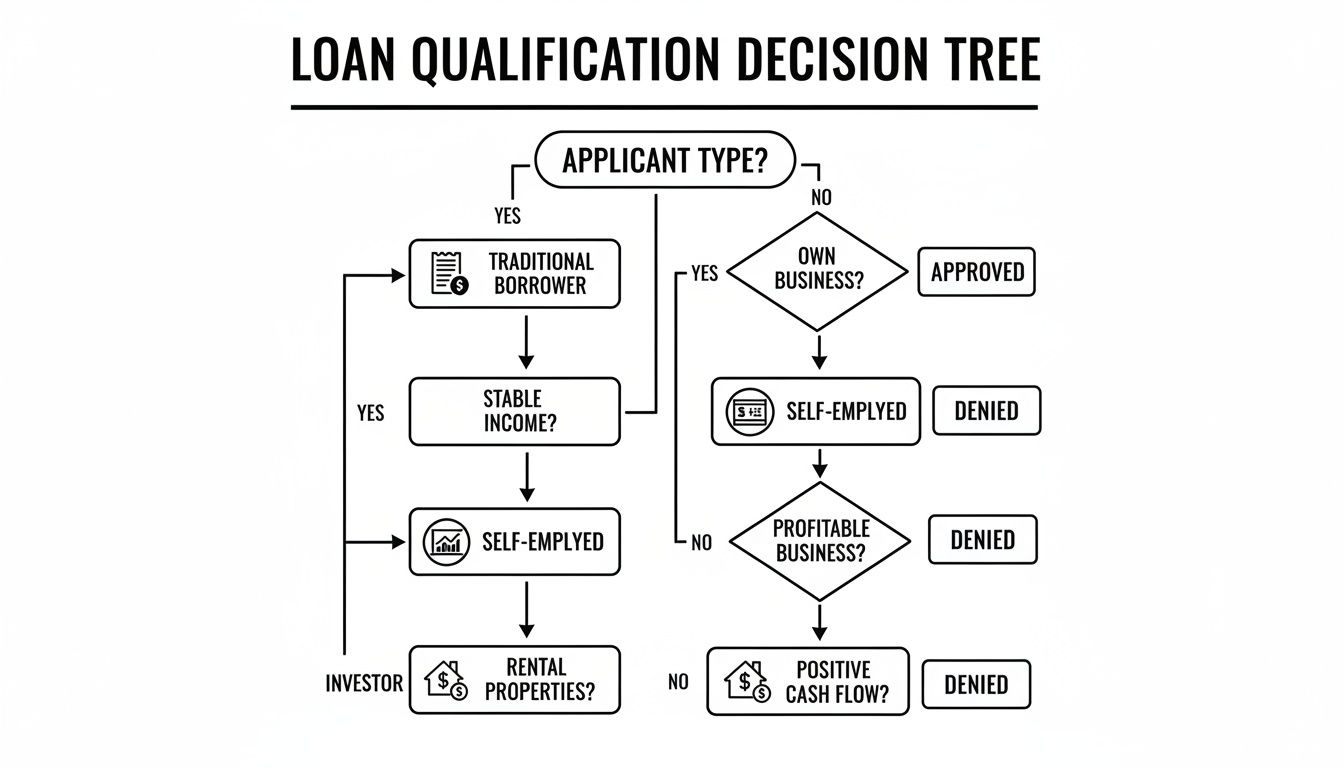
As you can see, the path to approval changes based on how you earn a living. A salaried employee might just need paystubs, while a business owner will need to open up their books with bank statements to prove their income.
FHA Loans: Flexible Credit Guidelines
What if your credit isn't perfect? That's where FHA loans come in. Because they’re insured by the Federal Housing Administration, lenders can be more forgiving with their underwriting standards. This opens the door for many homeowners who might not qualify for a conventional loan.
But this flexibility comes at a cost, specifically in the form of mortgage insurance.
An FHA cash-out refinance requires you to pay a Mortgage Insurance Premium (MIP). You'll pay a portion of it upfront at closing, and then a monthly premium is added to your mortgage payment for the entire life of the loan.
Here are the key FHA requirements:
- Maximum LTV: Just like conventional loans, the FHA caps your cash-out LTV at 80%.
- Minimum Credit Score: The FHA officially allows scores down to 580, but don't be surprised if most lenders you talk to set their own floor, usually around 620.
- Occupancy: This is a big one. FHA loans are strictly for the home you live in—your primary residence. You can't use an FHA loan to pull cash out of a vacation rental or investment property.
VA Loans: An Exclusive Benefit for Veterans
For those who have served, the VA loan program is one of the best benefits out there. Guaranteed by the Department of Veterans Affairs, these loans offer incredible terms that are hard to beat, especially for cashing out. In fact, the VA program is one of the only ways you might be able to borrow up to 90% of your home's value.
The VA program is in a class of its own for a few reasons:
- Maximum LTV: A generous 90% LTV gives you access to more of your equity than nearly any other loan type.
- No Mortgage Insurance: This is a huge money-saver. VA loans do not have monthly mortgage insurance, which can lower your monthly payment significantly compared to FHA or even some conventional loans.
- VA Funding Fee: Instead of mortgage insurance, most borrowers pay a one-time VA funding fee. The exact amount depends on your service history and if you've used a VA loan before, but it can often be rolled right into the new loan balance.
Jumbo Loans: For High-Value Properties
When your loan needs exceed the standard limits set by Fannie Mae and Freddie Mac (currently $766,550 in most parts of the country), you've entered jumbo loan territory. Because the lender is taking on more risk with such a large loan amount, the qualification requirements for a cash-out refinance become much more demanding.
Here’s what you can expect:
- Maximum LTV: Lenders are more conservative here. They'll typically cap the LTV for a jumbo cash-out at 70-75%, meaning you'll need to leave a larger equity cushion in the property.
- Minimum Credit Score: A top-tier credit score isn't just a suggestion; it's a must. Most lenders will want to see a score of at least 700, and many require 720 or even higher.
- Cash Reserves: Get ready to show you have plenty of liquid assets. Lenders will want to see that you have enough cash on hand to cover anywhere from 6 to 12 months of your new, larger mortgage payment after closing.
Your Property's Role: The Appraisal, Title, and Reserves

Getting a cash-out refinance isn't just about your personal finances; your property itself has to clear a few hurdles. After we’ve looked at your credit and income, the lender will turn a critical eye to the home through an appraisal and a title search. These aren't just formalities—they're fundamental steps that protect the lender’s investment.
Think of it this way: your financial profile proves you can repay the loan, but the property's value and legal history confirm there's a solid asset backing it. Getting a handle on these processes will help you set realistic expectations and avoid any eleventh-hour surprises on the path to closing.
The Home Appraisal: What's It Really Worth Today?
A fresh home appraisal is almost always required for a cash-out refinance. It doesn't matter if you had one a few years back; markets shift, and lenders need a current, impartial opinion on your property's value. This appraisal is the key to everything—it establishes the "V" in your Loan-to-Value (LTV) ratio, which ultimately decides the maximum amount you can borrow.
An appraiser will evaluate your home's condition, features, and location, comparing it to similar homes that have recently sold nearby. A strong valuation can unlock more equity, but a lower-than-expected appraisal might limit the cash you can pull out or even stop the loan in its tracks.
Making Sure the Title is Squeaky Clean
Before any money changes hands, the lender needs absolute certainty that they can secure a first-position lien on your property. This is where a title search comes in. It’s basically a deep-dive background check on your home's ownership history.
A title company digs through public records, looking for any hidden claims, old liens, or ownership squabbles that could threaten the lender's position. It’s all about ensuring the deed is free and clear.
- What are they looking for? Things like unpaid property taxes, liens from contractors who weren't paid, or unresolved claims from a previous owner.
- What happens if they find something? Any issues found, known as "clouds on the title," must be cleared up before you can close on the refinance.
- How is the lender protected? You'll be required to purchase a new lender's title insurance policy, which protects their investment against any title defects that might pop up down the road.
A clean title is the legal bedrock of your mortgage. Without it, a lender won't proceed because they can't be sure their investment is safe. It's a critical, behind-the-scenes requirement for any cash-out refinance.
Do You Need Cash Reserves?
Finally, let's talk about cash reserves. This is the liquid money you'll have left in the bank after closing the refinance and receiving your funds. This isn't money you pay to the lender; it's your own cash sitting in an account like a checking, savings, or brokerage account.
Lenders view reserves as your financial cushion. If you hit a rough patch and your income drops, they want to see that you can still cover the new, larger mortgage payment for a few months.
The reserve requirement is typically stated in months of your total mortgage payment, or PITI (Principal, Interest, Taxes, and Insurance). For instance, a lender might ask for six months of PITI in reserves. If your new monthly payment is $2,500, you’d need to show you have at least $15,000 in accessible funds remaining after the loan closes. While most common for investment properties and jumbo loans, this requirement can sometimes apply to other loans based on the lender's overall risk assessment.
Ready to Move Forward with Mortgage Seven LLC?
You've done the hard part—you've learned the ins and outs of cash-out refinance requirements. Now it's time to turn that knowledge into a plan of action. This is where we bridge the gap between understanding the rules and confidently making your next move.
Before you jump into an application, take a moment for a quick self-check. Do you tick the main boxes? Think of it like this: a good credit score, enough home equity, provable income, and a reasonable DTI are the four legs of the table. You need all of them to be sturdy. It's also about weighing the immediate benefit of cash in hand against the reality of a new, larger mortgage.
Your Personal Readiness Checklist
Use this quick checklist to see where you stand. It’s a simple way to spot any potential roadblocks before you officially apply.
- Equity: Will you still have at least 20% equity left in your home after the new loan closes?
- Credit Score: Is your score at or above the 620 mark? (Higher is always better for rates!)
- Income: Can you easily prove your income with W-2s, or will you need alternative documents like bank statements?
- DTI Ratio: Is your total debt-to-income ratio hovering somewhere below the 43-50% range?
Making a Smart Financial Move
The mortgage landscape is always changing. For example, back in November 2025, falling rates meant that an estimated 4.1 million U.S. homeowners were in a great position to refinance.
While a standard refinance is all about securing a lower rate, a cash-out refinance hinges on two things: having enough equity (usually keeping 20% in the home) and a strong credit profile—often a 660+ FICO score gets you the most competitive terms. You can dig into the numbers yourself in ICE's detailed mortgage analysis of that trend.
Working with an expert isn't just about getting a loan; it's about getting the right loan. The team at Mortgage Seven LLC is here to give you a personalized assessment, cut through the noise, and help you find the path that truly fits your financial goals.
As you prepare, arming yourself with knowledge from resources like these essential mortgage broker tips for success can make a world of difference in choosing the right professional to guide you.
Your home is likely your biggest asset, and tapping into its value is a major decision. You don't have to figure it all out on your own.
Reach out to the experts at Mortgage Seven LLC for a no-obligation consultation. We’ll look at your unique situation, answer all your questions, and lay out a clear, simple plan to help you get where you want to go.
Your Cash-Out Refinance Questions, Answered
Even after you've got a good handle on the basics, a few specific questions always seem to come up when you're considering a cash-out refinance. That's completely normal. Getting clear, straightforward answers is the best way to feel confident and avoid any last-minute surprises.
Here are the answers to some of the most common questions we hear from our clients at Mortgage Seven LLC.
How Long Does a Cash-Out Refinance Take From Start to Finish?
You can generally expect the entire process to take about 30 to 45 days. That's the typical window from the day you hand in your application to the moment the cash is yours.
It’s not a single event, but a series of steps. The journey usually looks something like this:
- Application & Paperwork: You gather and submit all your financial documents.
- Appraisal: We order an appraisal to determine your home’s current market value. This is a key step.
- Underwriting: The lender’s team does a deep dive into your file to make sure everything lines up with their guidelines.
- Closing: You sign the final loan papers.
- Funding: After a federally required three-day waiting period (your "right of rescission"), the funds are officially disbursed to you.
Of course, this timeline can vary. Working with a seasoned team like ours at Mortgage Seven LLC can make a real difference in keeping things moving smoothly, as we're always thinking one step ahead.
Are There Closing Costs for a Cash-Out Refinance?
Yes, just like with your original mortgage, a cash-out refinance has closing costs. Plan for them to be somewhere in the range of 2% to 5% of your new loan amount. It’s a crucial number to factor into your decision.
Good news, though: you don't necessarily have to pay these costs out of your pocket. Most of the time, you can roll them right into the new loan. This just means the amount of cash you receive at the end will be a little less, but it saves you from a big upfront expense.
Some of the standard costs you'll see on your closing statement include:
- Appraisal fees
- Title insurance and search fees
- Lender origination fees
- Credit report fees
- Recording fees
Can I Get a Cash-Out Refinance on an Investment Property?
Absolutely. Pulling cash out of an investment property is a fantastic strategy for seasoned investors looking to free up capital for their next deal. But you should know that the rules are a bit tighter compared to refinancing your own home.
Lenders see investment properties as carrying a bit more risk, so they adjust their requirements accordingly. You'll likely face a lower maximum loan-to-value (LTV) limit, usually capping out at 70% or 75%. This means you'll have to leave more equity in the property. They'll also probably want to see a higher credit score and more significant cash reserves.
At Mortgage Seven LLC, we work with all kinds of borrowers, including real estate investors who need creative and reliable financing. To see what specialized programs might work for you, a great place to start your journey is at https://mtg7.com.