Securing the financing to build your dream home is a major milestone. To get there, you'll need to understand what lenders are looking for. It really boils down to three main areas: your personal financial picture, the project's numbers, and the credentials of your build team. Lenders need to see the whole puzzle to feel confident that the project is a solid investment for everyone.
Your Financial Blueprint for Getting Approved

The journey from an empty lot to a finished home is thrilling, but it all starts with a strong financial foundation. Don't think of the loan application as just another pile of paperwork; it's the financial blueprint for your entire project. Just like architectural plans guide the construction crew, your financial documents show the lender that your vision is achievable and a low-risk venture.
Lenders look at your application from a few different angles to get a complete sense of the risk involved. They want to see a reliable borrower, a project that makes financial sense, and a competent team to bring it all to life. Getting a handle on these key areas is your first step toward a smooth approval.
Key Pillars of Construction Loan Approval
To give you a clearer picture, here’s a quick breakdown of what lenders focus on. Think of these as the main pillars supporting your loan application.
| Pillar of Approval | What Lenders Look For |
|---|---|
| You, The Borrower | Your personal financial health is front and center. Lenders review your credit history, income, assets, and existing debt to make sure you can handle the new loan payments. |
| The Project Itself | The numbers have to work. This means a detailed analysis of the construction budget, the "as-completed" appraisal value, and the overall cost to ensure the project is financially viable. |
| Your Professional Team | The lender is investing in your builder's ability to perform. They'll need to see that your General Contractor is licensed, insured, and has a proven track record of finishing projects on time and on budget. |
Each of these pillars provides the lender with critical information they need to fund your build with confidence.
By preparing thoroughly in each of these three areas, you're showing the lender that your project is built on a foundation of stability, realistic planning, and professional expertise. Being proactive here dramatically boosts your chances of getting that approval.
Navigating these requirements is much less intimidating when you're prepared. Working with a trusted advisor like Mortgage Seven LLC can help you put together a strong, comprehensive application that checks every box.
Choosing Your Path: Construction vs. Permanent Loans
Building a home from the ground up is an exciting journey, but the financing can feel a little complicated at first. Unlike buying an existing home, you’re not just getting one standard mortgage. You're financing the entire construction process, and there are two main ways to go about it.
Think of it this way: are you taking a direct flight or one with a layover? The path you choose will have a big impact on your budget, your stress levels, and the overall process. Let's break down the two primary options: the Construction-to-Permanent loan and the Stand-Alone Construction loan.
Understanding the pros and cons of each is the first critical step in navigating your construction loan requirements.
The All-in-One Route: Construction-to-Permanent Loans
This is the direct flight. Often called a single-close or one-time close loan, this popular option bundles everything into one neat package. You apply once, qualify once, and sign all the paperwork at a single closing before the first shovel ever hits the ground.
Here’s why so many people prefer this streamlined approach:
- Rate Security: You lock in your permanent mortgage interest rate from day one. This is huge. It completely removes the risk of rates climbing during the 12-18 months it might take to build your home.
- Cost Savings: One closing means one set of closing costs. You're not paying for title insurance, appraisals, and attorney fees twice, which can easily save you thousands.
- Smooth Transition: The moment your home is finished and passes its final inspection, the loan just rolls over into a regular mortgage. No re-applying, no more paperwork, no more stress.
This simplicity and financial predictability make the single-close loan a fantastic choice for most homebuyers who want to keep things as straightforward as possible.
The Two-Step Approach: Stand-Alone Construction Loans
This is your connecting flight. The Stand-Alone or two-close loan splits the financing into two distinct phases. First, you get a short-term, interest-only loan to cover the cost of construction. Once the house is built, you have to apply for a brand new, separate mortgage to pay off that initial construction loan.
With a two-close loan, you are essentially betting on your financial situation remaining stable—or even improving—and that interest rates will be favorable when your home is complete. This introduces an element of risk that a single-close loan avoids.
Going through the full underwriting and closing process twice is definitely more work, but it offers a bit of flexibility. For instance, if your credit score jumps up while the house is being built, you might land a better rate on your final mortgage.
But the risk is real. What if rates have gone up? What if your job situation changes? You could find yourself struggling to qualify for that second loan. For this reason, this path often appeals to builders or borrowers with very strong financial profiles who are comfortable with the added risk.
Comparing Loan Types: Construction-to-Permanent vs. Stand-Alone
To make the choice clearer, let's put these two loan structures side-by-side. This table breaks down the key differences to help you decide which path aligns best with your financial strategy and comfort level with risk.
| Feature | Construction-to-Permanent (Single-Close) | Stand-Alone Construction (Two-Close) |
|---|---|---|
| Closings | One single closing before construction starts. | Two separate closings: one for the build, one for the permanent mortgage. |
| Qualification | You qualify just once at the beginning. | You must qualify for the construction loan and re-qualify for the permanent loan. |
| Interest Rate | Permanent mortgage rate is locked in upfront. | Rate is locked only when you apply for the permanent mortgage after construction. |
| Closing Costs | One set of closing costs. | Two sets of closing costs, making it more expensive. |
| Risk | Lower risk; protected from rising rates and changes in financial status. | Higher risk; you're exposed to interest rate changes and re-qualification risk. |
| Best For | Most homebuyers, especially those seeking simplicity and financial certainty. | Speculative builders or borrowers with strong finances who want flexibility. |
Ultimately, the right loan depends on your personal circumstances. The single-close loan provides peace of mind, while the two-close option offers a potential upside for those willing to take on more risk.
Getting Your Finances in Order: What Lenders Look For

Before any lender agrees to fund your dream home, they need to see that your own financial house is in order. This isn't just a box-ticking exercise; they're trying to get a clear picture of your reliability as a borrower. It all boils down to three key areas: your credit score, your debt-to-income ratio, and the cash you have on hand.
I like to think of these as the three legs of a stool. If one is shaky, the whole thing gets wobbly. To get through the tough underwriting process for a construction loan, you’ll want to make sure all three are as strong as possible.
Your Credit Score: The First Impression
Your credit score is the first thing a lender will look at, and with construction loans, the bar is set a little higher than for a typical home purchase. Most lenders want to see a minimum score of 680, but a score of 720 or higher is what really gets their attention and opens up the best terms.
But the number itself is just the headline. An underwriter will dig into your full credit report to understand the story behind that score. They're looking for a long history of paying your bills on time and managing debt responsibly. A late payment from five years ago isn't a deal-breaker, but a recent pattern of missed payments? That’s a major red flag that signals you might be under financial stress.
At the end of the day, a solid credit history is your proof to the lender that you're a dependable borrower who honors their commitments. For a deeper dive into how lenders view your credit, you can find more information here.
Debt-to-Income Ratio: Can You Handle the Payments?
Your Debt-to-Income (DTI) ratio is a simple but powerful number. It tells lenders what slice of your monthly income is already spoken for by existing debt—think car loans, student loans, credit card bills, and any other mortgages.
DTI Ratio = Total Monthly Debt Payments ÷ Gross Monthly Income
Let’s run a quick example. Say you bring in $10,000 a month before taxes, and all your current debts plus the new estimated mortgage payment add up to $4,000. Your DTI would be 40%. For construction loans, lenders almost always want to see a DTI of 43% or lower. Go much higher than that, and they start to worry that you might be stretched too thin to comfortably manage another payment.
Cash Reserves: Your Financial Safety Net
Finally, lenders need to see you have a solid financial cushion. Cash reserves are the liquid funds you have left over after you've paid the down payment and all the closing costs. This isn't just about having money in the bank; it’s about proving you can weather the inevitable storms of a construction project.
Building a home is famous for its surprises—unexpected delays, material cost spikes, you name it. Your reserves tell the lender you can handle these bumps without derailing the project or, worse, defaulting on the loan.
Here’s what lenders are typically looking for:
- A Healthy Buffer: Most want to see you have enough cash to cover 6 to 12 months of your new mortgage payments (principal, interest, taxes, and insurance).
- Easy Access: This money needs to be in liquid accounts like checking, savings, or a money market. While some retirement funds can be counted, they often come with strings attached.
Having strong cash reserves is one of the best ways to signal to a lender that you're a low-risk borrower who is truly prepared for the journey of building a home.
Understanding the Project's Financial Metrics
Once you’ve cleared the personal finance hurdles, the lender puts the project itself under the microscope. Think of them as your financial co-pilot for this journey—they need to be sure the plan is sound and the investment is safe for everyone involved. It’s not just about the total price tag; they dig into specific numbers that tell the real story of the project's financial health.
Two of the most important metrics you'll hear about constantly are Loan-to-Value (LTV) and Loan-to-Cost (LTC). They might sound alike, but they give the lender two completely different views on risk. Getting a handle on these is absolutely essential.
Loan to Cost vs. Loan to Value
So, what’s the difference?
Loan-to-Cost (LTC) is pretty straightforward: it compares the loan amount to the total cost to get the project done—that’s the land purchase plus all your construction costs. Lenders live and die by this number during the building phase because it shows them exactly how much of your own money you have in the deal. It's all about your "skin in the game."
On the other hand, Loan-to-Value (LTV) compares the loan amount to what the home is expected to be worth after it’s finished. This is the future appraised value. LTV becomes the key metric once construction is complete and you’re moving into a permanent mortgage.
For a construction loan, the lender is almost always more focused on the LTC. A lower LTC tells them you’ve put a significant amount of your own cash or equity into the project, which naturally reduces their risk and proves you're committed.
Let's run through a quick example to see how this works in the real world.
- Land Cost: $200,000
- Construction Cost: $800,000
- Total Project Cost: $1,000,000
- Future Appraised Value: $1,200,000
If a lender approves a $750,000 loan, your LTC would be 75% (that's $750k divided by the $1M total cost). Your LTV, however, would be 62.5% ($750k divided by the $1.2M future value). Most lenders will cap the LTC somewhere between 70-80%, meaning you’re on the hook for the rest.
The Growing Need for Borrower Equity
Lately, we've seen lenders get a lot more cautious. Since 2023, the amount of equity they expect borrowers to bring to the table has crept up. Where 15-20% might have been enough before, now they’re often looking for 25-30% of the total project cost.
What this means is that typical LTC limits have dropped from the 80-85% range down to about 70-75% for 2024-2025. For that same $1 million project, you'd now need to come up with $250,000 to $300,000 in cash or land equity, a big jump from the $200,000 it might have been a few years ago.
Building Your Financial Safety Net
Your down payment isn’t the only cash you’ll need. Lenders will also require you to have a contingency reserve.
This is a separate pot of money, usually 5-15% of the total construction cost, that’s earmarked for the unexpected. And in construction, you can bet the unexpected will happen. This reserve is your buffer against things like a sudden spike in lumber prices, surprise foundation issues, or weather delays that throw your timeline off track.
This fund is non-negotiable. It protects both you and the lender from budget overruns, ensuring a minor hiccup doesn’t bring the entire project to a screeching halt. You can use our online financial tools to help estimate your project's potential costs and reserves.
Assembling Your Dream Team and Documentation
Getting a construction loan approved is about more than just your personal finances. You're essentially presenting a complete business plan for your new home, and the lender needs to see that you've put together a solid team and a rock-solid plan.
Think of it this way: you wouldn't invest your own money in a project with a questionable team and a vague roadmap. Neither will a bank. They'll scrutinize your builder as closely as your credit score and pour over your blueprints with the same intensity they give your bank statements.
Your Project and Professional Crew
First things first, the lender needs to trust the person holding the hammer. Your General Contractor is the most critical player on your team, and lenders are incredibly particular about who they'll work with. They're looking for an experienced, licensed, and insured builder because that expertise is what protects their investment—and yours.
You'll need to submit a full "builder's package" that proves they're up to the job. This usually includes:
- Proof of Licensing and Insurance: This shows they're legally cleared to work in your area and are covered if anything goes wrong.
- A Portfolio of Completed Projects: Lenders want to see that your builder has a track record of finishing homes similar in size and quality to what you're planning.
- Financial Statements or References: This confirms the builder's business is on solid financial ground and can handle a project of this magnitude without issues.
A crucial part of this is ensuring you have the right coverage in place. You'll need a comprehensive understanding of builders risk insurance, which is designed to protect the property itself while it's under construction.
The Paperwork That Builds the Case
With your builder vetted, the next step is submitting all the project-specific documents. This paperwork is the heart of your application, giving the underwriter a clear, detailed picture of what you intend to build and how you'll do it. Vague plans or incomplete budgets are a surefire way to get rejected.
Lenders won’t approve a loan based on an idea; they approve it based on a meticulously detailed plan. Every line item in your budget and every measurement on your blueprints must be accounted for to build the lender's confidence.
Your project documentation checklist must include:
- Full Architectural Plans: These are the actual blueprints showing floor plans, elevations, and all the structural details.
- A Line-Item Budget: Often called a "Schedule of Values," this is a detailed cost breakdown for everything from the foundation concrete to the doorknobs.
- A Detailed Materials List: This document, sometimes called "specs," outlines the specific quality and type of materials you'll be using.
- The Signed Construction Contract: This is the legally binding agreement between you and your builder that details the scope of work, the timeline, and the payment schedule.
- All Necessary Building Permits: Lenders won't release a dime until you can prove the local building authorities have officially approved your project.
From Appraisal to Final Draw: Managing Your Construction Funds
Getting your construction loan approved is a fantastic feeling, but it's really the starting line, not the finish. Once you close on the loan, the way the money works is completely different from a typical mortgage. The entire process is built to protect you and the lender, making sure the project hits its milestones and stays on budget from the first shovel of dirt to the final coat of paint.
It all kicks off with a unique kind of appraisal. Before the loan is finalized, an appraiser will look at your detailed blueprints and list of materials to determine the home's future value—what it will be worth once it's built. This "as-completed" value is a make-or-break number for the lender, as it confirms the project is a sound investment and helps set the final loan amount.
How the Draw Schedule Works
With a normal home purchase, the seller gets all their money at once. A construction loan is the opposite. The funds are released in stages as work is completed, following what’s known as a draw schedule. Think of it as releasing payments only after specific project milestones are hit.
This flowchart shows how all the pieces—you, the project plans, and your construction team—fit together to keep the funding process moving smoothly.
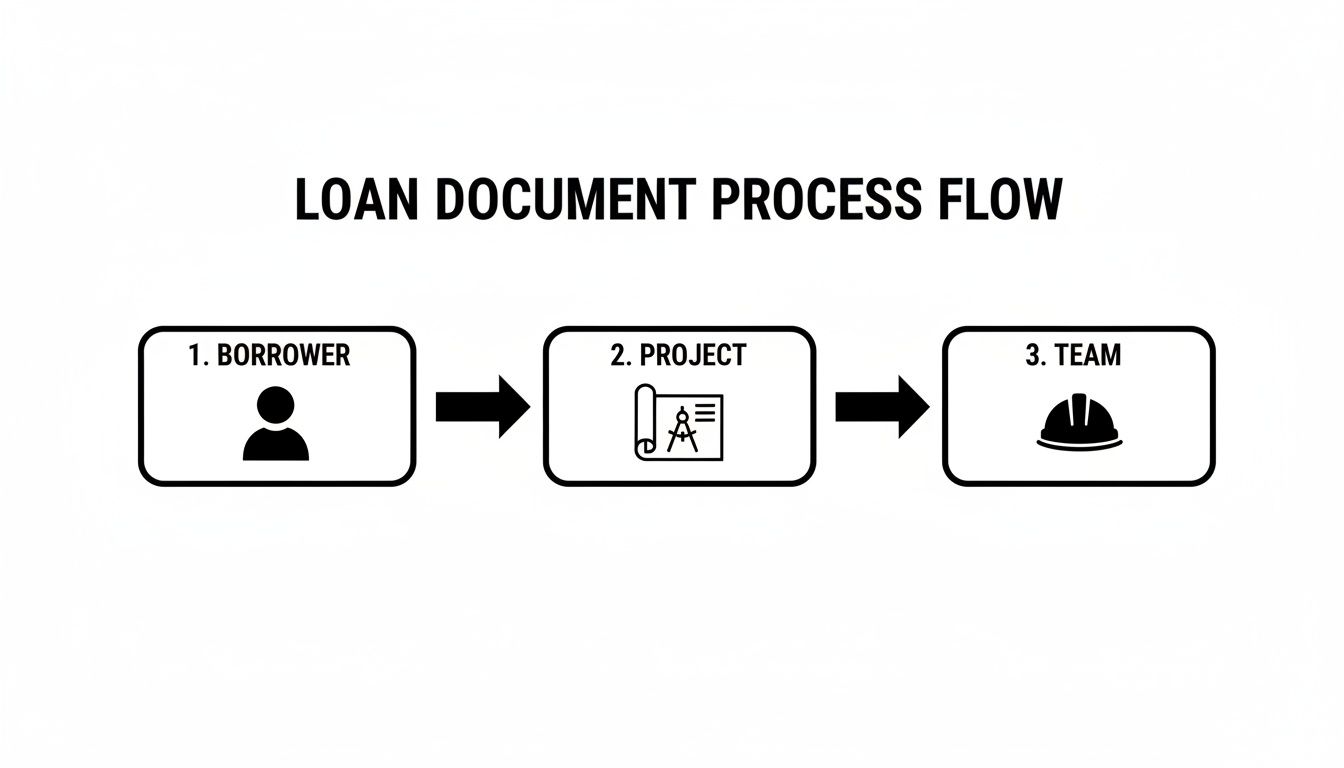
As you can see, a successful build depends on the constant, clear communication between your financial documents, the project's blueprints, and the vetted professionals doing the work.
The draw schedule is tied directly to visible progress on the job site. A common schedule might follow these key phases:
- Draw 1: Foundation is poured and has fully cured.
- Draw 2: The framing is up and the roof is on.
- Draw 3: Exterior doors, windows, and siding are installed.
- Draw 4: Rough-ins for plumbing, electrical, and HVAC are complete.
- Draw 5: Interior work like drywall, flooring, and painting is finished.
Now, here's the crucial part: before a single dollar from a draw is released, the lender sends an inspector to your property. Their only job is to confirm that the work for that milestone is 100% complete and up to standard. This is the system's most important safeguard.
This system of inspections and milestone-based draws is designed to prevent a nightmare scenario where a builder gets paid for work that they haven't actually finished. It directly connects the money to real, tangible progress on your new home.
This methodical system keeps everyone honest and accountable. You can see a complete overview of our step-by-step loan management processes to understand how we keep things transparent. It’s a proven approach that reduces risk and keeps your dream home build on the right track.
Your Construction Loan Questions Answered
Even the most well-prepared borrowers run into questions and "what-if" scenarios when planning a build. Let's tackle some of the most common ones head-on so you can move forward with confidence.
What Happens If My Construction Costs Go Over Budget?
This is a classic question, and it's the very reason lenders require a contingency reserve. Think of it as a built-in safety net.
This fund, typically 5-15% of the total construction cost, is set aside specifically for surprises—like a sudden jump in lumber prices or an unexpected issue with the land that requires extra site work.
If you burn through that reserve, you'll almost always have to cover the overages out of your own pocket. This is why a rock-solid contract with your builder, one that spells out exactly how cost overruns are handled, is so important. Keeping an open line of communication with your lender is just as crucial to keep the project on track.
Can I Be My Own General Contractor?
It's a tempting thought, especially if you're handy, but acting as your own general contractor (GC) makes getting a loan much, much harder.
Lenders see professional GCs—licensed, insured, and with a proven track record—as their best insurance policy that the home will be built correctly, on time, and on budget. These are often called "owner-builder" loans, and most lenders simply won't touch them.
A few niche lenders might entertain the idea, but be prepared for a very high bar. They'll likely demand a significantly larger down payment and much deeper cash reserves to offset the risk.
How Do Construction Loan Interest Rates Work?
This is a key area where construction loans differ from a standard mortgage. They are short-term loans, usually for 12-18 months, and you make interest-only payments during the build.
Here's the important part: You only pay interest on the funds that have been drawn and paid to your builder, not on the full loan amount from day one. This keeps your monthly payments much more manageable while the house is going up.
The interest rate is typically variable, tied to an index like the Prime Rate. Once the home is finished, the loan is either converted into a permanent mortgage (in a one-time close loan) or you refinance it into a new, traditional mortgage with a fixed rate.
What Are the Challenges for Self-Employed Applicants?
If you're self-employed, the biggest hurdle is documenting a stable, reliable income. Lenders will need to see more paperwork than they would for a W-2 employee. You should be ready to provide at least two years of full business and personal tax returns, plus a recent Profit & Loss (P&L) statement. For a great deep dive into this, check out this guide on mastering construction loan requirements.
Real estate investors get a similar level of scrutiny. Lenders will want to see the project's profit potential and will often ask for a larger down payment and more cash reserves to feel comfortable with the risk. The good news is that there are loan programs designed specifically for these situations.
Trying to figure out construction financing on your own, especially with a unique income situation, can be overwhelming. This is where getting the right advice really pays off. The team at Mortgage Seven LLC lives and breathes this stuff, and we're experts at matching borrowers—including entrepreneurs and investors who need bank-statement or DSCR programs—with the right loan. To get straight answers for your project, schedule a consultation today.