When you're gearing up to buy a home, your credit score is one of the first things a lender will look at. But here’s the thing: there isn't one single "magic number" that works for everyone. While some government-backed loans might approve a score as low as 580, most conventional lenders really want to see a 620 or higher.
If you're aiming for the best possible interest rates—the kind that save you serious money over the long haul—you'll want to be in the 740+ club.
Your Mortgage Journey Begins with a Single Number
Think of your credit score as your financial handshake. It's a three-digit number, usually between 300 and 850, that gives lenders a quick snapshot of your history with debt. In their eyes, a higher score means you’ve managed credit responsibly, making you a reliable bet. This one number is incredibly influential in your home-buying journey.
A strong score does more than just get your foot in the door for an approval. It directly impacts the deal you're offered. Lenders reserve their best interest rates for borrowers who present the least risk, and that translates into real, tangible savings for you.
The Power of a High Score
Just how big of a difference can a few points make? A massive one. Let’s look at a typical home loan of $402,873. If you have an excellent score—say, in the 760-850 range—you could land an APR around 6.5%. But if your score is below 660, that rate could jump to 7.9% or even higher.
That difference might not sound huge at first, but it means you’d be paying about $165 more every single month. Over the 30-year life of the loan, that adds up to a staggering $59,274 in extra interest. If you want to dive deeper, you can explore more data on how mortgage rates vary by credit score to see the full picture.
Getting a handle on this relationship is the first real step toward getting the keys to your new home. It’s not just about hitting the minimum credit score for a mortgage; it’s about setting yourself up for the best financial outcome.
Your credit score is more than just a number—it’s a direct reflection of your financial habits. Lenders use it to predict future behavior, making it a cornerstone of their decision-making process.
So, let's break down exactly what your score influences when you apply for a mortgage:
- Approval Likelihood: A higher score opens more doors and significantly boosts your chances of getting a "yes" from a wider variety of lenders.
- Interest Rate: This is where you feel the most immediate impact. Better scores mean lower rates, which leads to a lower monthly payment.
- Loan Options: Some of the best loan programs are only available to borrowers who meet a certain credit benchmark.
- Associated Costs: Your score can even influence other expenses, like the premiums on your Private Mortgage Insurance (PMI), which could add to your monthly cost if your score is on the lower side.
To see this in action, let's look at how APRs can change across different credit score tiers for a 30-year fixed-rate mortgage. The differences in monthly payments and long-term interest costs are striking.
Credit Score Tiers and Potential Mortgage APRs
| Credit Score Range | Credit Quality | Example APR | Monthly Payment | 30-Year Interest Savings (vs. 620-639) |
|---|---|---|---|---|
| 760-850 | Excellent | 6.6% | $2,569 | $58,320 |
| 700-759 | Good | 6.8% | $2,621 | $40,680 |
| 680-699 | Fair | 7.1% | $2,699 | $20,160 |
| 660-679 | Average | 7.4% | $2,778 | $6,120 |
| 640-659 | Below Average | 7.8% | $2,885 | $1,800 |
| 620-639 | Poor | 8.0% | $2,955 | $0 |
As the table shows, climbing from "Poor" to "Excellent" credit doesn't just feel good—it can put nearly $60,000 back in your pocket over the life of your loan. This is exactly why putting in the effort to improve your score before you apply is one of the smartest moves a homebuyer can make.
Which Mortgage Is Right for You? A Look at Credit Score Requirements
Not every homeownership journey follows the same script, and the mortgage world is built to reflect that. Lenders have a whole menu of loan programs, each designed for different financial situations and, you guessed it, each with its own specific credit score guidelines.
Think of it like this: you wouldn't use a sledgehammer to hang a picture frame. The same logic applies here. A conventional loan is a fantastic tool, but it's not always the right one for every buyer. This is where government-backed loans and other specialized options come in, often creating a path to homeownership for people who might not otherwise qualify.
This decision tree gives you a quick visual of how your credit score directly shapes the interest rate you'll likely be offered.
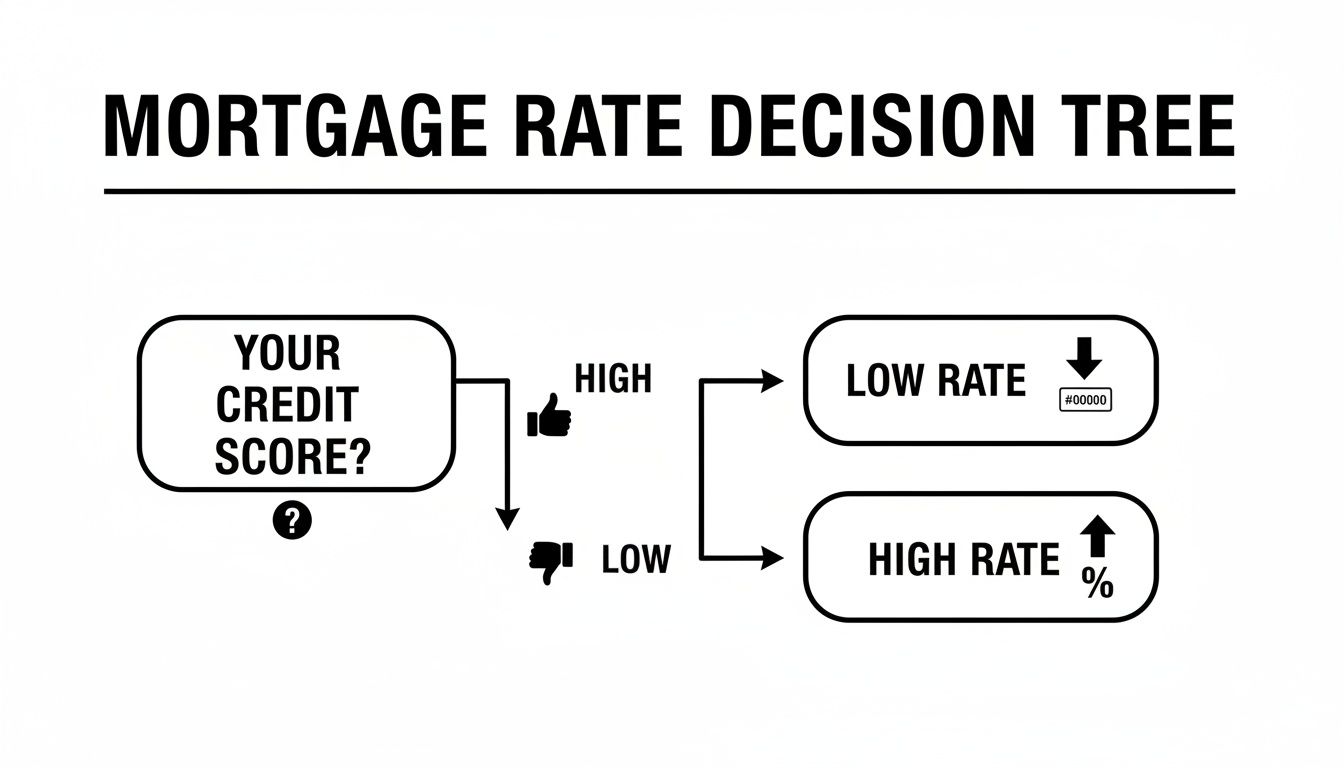
As you can see, a higher score generally leads to a lower rate, saving you a significant amount of money over the life of your loan. A lower score, on the other hand, means lenders see more risk, which translates to higher borrowing costs for you.
Conventional Loans: The Gold Standard
Conventional loans are the bread and butter of the mortgage industry. They aren't backed by any government agency, which means the lender assumes all the risk if you default. Because of this, their qualifying standards are typically more strict.
- Minimum Credit Score: You'll generally need a FICO score of at least 620 to even be in the running.
- Ideal Credit Score: To get the best-of-the-best interest rates and most favorable terms, lenders really want to see a score of 740 or higher.
A great score on a conventional loan application does more than just lower your interest rate. It can also help you reduce or completely avoid Private Mortgage Insurance (PMI), which is an extra monthly fee lenders require when your down payment is less than 20%.
Government-Backed Loans: Opening the Door to Homeownership
For many homebuyers, the strict requirements of conventional loans can be a roadblock. This is where government-backed programs become a game-changer. These loans are insured by federal agencies, giving lenders a safety net that allows them to approve borrowers with more flexible credit and down payment profiles.
The entire point of government-backed loans is to make buying a home more attainable for more people. By insuring these mortgages, agencies like the FHA, VA, and USDA empower lenders to say "yes" to borrowers with lower credit scores or less cash for a down payment.
Here’s a quick look at the most common options:
- FHA Loans: Insured by the Federal Housing Administration, these are a favorite among first-time homebuyers. The absolute rock-bottom minimum score is 500 (if you can put down 10%), but the real sweet spot is 580 or higher. A 580 score makes you eligible for the popular 3.5% down payment program.
- VA Loans: Guaranteed by the Department of Veterans Affairs, this is an incredible benefit for eligible veterans, active-duty service members, and some surviving spouses. The VA itself doesn't set a credit score floor, but most lenders who issue these loans will want to see a score of at least 620.
- USDA Loans: Backed by the U.S. Department of Agriculture, these loans target low-to-moderate-income buyers in designated rural and suburban areas. To qualify, most USDA-approved lenders will require a minimum credit score of 640.
Specialized Loans for Unique Financial Situations
What if you're a real estate investor or a self-employed entrepreneur? Your financial picture might not fit neatly into the conventional or government-backed boxes. That’s where specialized, or "non-QM" (non-qualified mortgage), loans come into play.
These loans use alternative ways to verify your ability to repay, looking beyond traditional W-2s and tax returns. They offer amazing flexibility, but that often comes with slightly higher rates or stricter credit score minimums to offset the lender's perceived risk.
- DSCR Loans: Short for Debt Service Coverage Ratio, this loan is built for real estate investors. The lender qualifies you based on the investment property's cash flow, not your personal W-2 income. Most lenders set the minimum credit score at 660, but you'll find much better terms with a score over 720.
- Bank-Statement Loans: A lifesaver for self-employed borrowers, freelancers, and gig workers. Instead of tax returns, you'll use 12 to 24 months of personal or business bank statements to prove your income. Lenders typically look for a minimum credit score of 660, though a few may go down to 620.
- ITIN Loans: This loan is for non-U.S. citizens who work and pay taxes using an Individual Taxpayer Identification Number (ITIN) instead of a Social Security Number. The requirements can vary significantly from lender to lender, but a credit score of 680 or higher is a common prerequisite.
No matter the market, a strong credit history is the engine that drives your mortgage options. As recent data from TransUnion shows, while the mortgage market is picking up, it's borrowers with prime scores of 720+ who are leading the charge. This trend highlights just how valuable it is to work on your credit before you start shopping for a home. You can read more about current mortgage market trends from TransUnion to get a better sense of the current landscape.
The True Financial Impact of Your Credit Score
Getting approved for a mortgage feels like the finish line, but it’s really just the starting gun. The real victory isn't just getting the loan; it's getting a loan that won’t break your budget for the next 30 years. And the single biggest factor that shapes that deal? Your credit score.
Imagine two people buying identical houses, for the exact same price, on the same street. One of them will end up paying tens of thousands of dollars less over the life of the loan. The only difference? A stronger credit profile. This isn't just a hypothetical scenario—it's the everyday reality of mortgage lending.

This section isn't just about meeting the minimum credit score for mortgage approval. It's about pulling back the curtain to show you how every single point can directly affect your bank account for decades to come, from interest rates to other hidden costs.
How Your Score Translates into Dollars and Cents
To a lender, your credit score is a simple risk meter. A high score tells them you're a reliable borrower, and they reward that reliability with a lower interest rate. A lower score signals a higher chance of default, so they charge you more to offset that perceived risk.
Let's put some real numbers to this. Picture this scenario: you're applying for a $350,000 mortgage on a standard 30-year fixed loan.
- Borrower A (760 Credit Score): Qualifies for a 6.7% interest rate. Their monthly principal and interest payment works out to about $2,252.
- Borrower B (650 Credit Score): Is offered the same loan but at a 7.9% interest rate. Their monthly payment is $2,540.
That’s a $288 difference every single month. It might not seem like a deal-breaker at first glance, but the long-term cost is jaw-dropping. Over the 30-year loan term, Borrower B will pay over $103,000 more in interest than Borrower A for the exact same house. It's a perfect example of how a relatively small gap in credit scores can create a massive financial divide over time.
A difference of just 50 points on your credit score can easily translate into paying an extra $30,000 to $50,000 in interest over the life of a typical home loan. Improving your score before you apply is one of the highest-return investments you can make.
The Hidden Cost of Private Mortgage Insurance (PMI)
The impact doesn't stop at your interest rate. If you're getting a conventional loan and putting down less than 20%, you’ll almost certainly have to pay for Private Mortgage Insurance (PMI). This is an insurance policy you pay for that protects the lender, not you.
Here's the kicker: the cost of your PMI premium is also dictated by your credit score. Lenders use what's called risk-based pricing, which means borrowers with lower scores get hit with much higher PMI rates.
Let’s look at two buyers, each putting 10% down on a $400,000 home:
- Excellent Credit (760+): Might pay a PMI rate of 0.35% of the loan amount per year. This adds roughly $105 to their monthly payment.
- Fair Credit (640-659): Could be looking at a PMI rate of 1.15%. This tacks on a much more painful $345 to their monthly payment.
That's an extra $240 per month—or $2,880 per year—just for having a lower credit score. And remember, that’s on top of the higher interest rate you're already paying. This extra cost eats directly into your purchasing power, making homeownership more expensive month after month.
At the end of the day, your credit score is much more than a simple gatekeeper for loan approval. It's the master key that unlocks the total cost of your home. When you understand its true financial power, you can shift your mindset from just qualifying to securing the best possible financial footing for your future.
An Actionable Plan to Boost Your Mortgage Readiness
Knowing your credit score is the first step. Turning that number into one that gets you the best mortgage deal? That’s where the real work begins. We're not talking about generic financial advice here; this is a strategic playbook designed to tackle the specific things mortgage lenders scrutinize the most. A higher score isn't just about pride—it directly translates into a lower interest rate, a smaller monthly payment, and thousands of dollars saved over the life of your loan.
Let's walk through a concrete plan to get your credit profile in top shape. We'll cover some quick wins that can show results in just a few weeks, as well as the long-term habits that build a rock-solid financial foundation. Think of this as your roadmap to confidently securing the keys to your new home.

Target Your Credit Utilization Ratio
If there’s one "magic button" you can press for a quick score boost, this is it. Your credit utilization ratio is simply the amount of credit you're using compared to your total available credit limit. To a lender, a maxed-out credit card is a major red flag—it looks like you might be overextended.
Let's say you have a total credit limit of $10,000 across all your cards. If you're carrying a combined balance of $5,000, your utilization is 50%. The sweet spot is keeping that number below 30%, but if you can get it under 10%, you’ll really see your score climb.
Pro Tip: Time your payments strategically. Paying down your credit card balances right before the statement closing date can make a huge difference. Lenders report your balance to the bureaus on that date, so your hard work can show up on your credit report in as little as 30 to 45 days.
Scrub Your Credit Report for Errors
You’d be shocked at how often credit reports have mistakes. A major consumer study found that over a third of people discovered at least one error on their report. These slip-ups, whether it’s a late payment that wasn't actually late or an account you never opened, can be an anchor on your score.
You have the right to get a free credit report every year from the big three bureaus: Equifax, Experian, and TransUnion. Go through each one with a fine-tooth comb and look for:
- Incorrect Personal Information: Old addresses, misspelled names, or past employers you don't recognize.
- Accounts You Didn't Open: This is a serious warning sign for identity theft.
- Inaccurate Payment Status: A bill you paid on time that's been marked "late."
- Duplicate Accounts: The same loan or credit card showing up twice, which can skew your debt-to-income ratio.
If you spot an error, dispute it with the credit bureau right away. The correction process can take a month or two, so this is a task you want to handle well before you start house hunting. Fixing these mistakes can give your credit score for mortgage eligibility a significant and well-deserved lift.
Build a Flawless Payment History
Lowering your credit card balances is a great short-term fix, but nothing beats a long and consistent track record of paying your bills on time. Your payment history is the heavyweight champion of credit score factors, making up a massive 35% of your FICO score.
A single 30-day late payment can knock dozens of points off your score and will haunt your report for seven years. The easiest way to avoid this is to set up automatic payments for everything—credit cards, car loans, student loans, even your utility bills. It's a simple habit, but it’s the bedrock of a five-star credit profile.
Improving your credit can feel like a marathon, not a sprint. Here's a quick look at what to focus on and how long it might take to see a difference.
Credit Improvement Action Plan and Timeline
| Action Item | Impact Level (High/Medium/Low) | Estimated Time to See Score Change | Pro Tip for Mortgage Applicants |
|---|---|---|---|
| Pay Down Credit Card Balances | High | 30-45 Days | Aim to get balances below 10% of your limit for the biggest impact. |
| Dispute Report Errors | High | 30-60 Days | Start this process 3-4 months before you plan to apply for a mortgage. |
| Make All Payments On Time | High | 6-12 Months (for new history) | Set up auto-pay for all accounts to build an undeniable track record. |
| Become an Authorized User | Medium | 30-60 Days | Only do this on an account with a long history and low balance. |
| Avoid Opening New Accounts | Low (prevents score drop) | Immediate | Resist store card offers and new loans while house hunting. |
This table is a great guide, but remember, every credit profile is unique. The key is to start taking positive action as soon as you can.
Avoid New Credit Applications
Once you decide to buy a home, it's time to put your credit on lockdown. Every time you apply for a new loan or credit card, the lender pulls your report, resulting in a hard inquiry. One inquiry might only ding your score by a few points, but a flurry of them in a short time makes lenders nervous. It looks like you're desperate for credit.
So, for now, you'll need to resist the temptation to:
- Sign up for that new credit card with the great travel rewards.
- Finance a new car, furniture, or any other large purchase.
- Open a store credit card just to get a 20% discount.
Lenders need to see a stable financial picture right before closing. Once the keys to your new home are in your hand, you can revisit those other financial goals. Want to see how these choices could impact your bottom line? You can use our online tools to explore various mortgage payment scenarios and get a clear picture of your budget.
Getting a Mortgage When You're Self-Employed
For freelancers, small business owners, and anyone working in the gig economy, the road to getting a mortgage often has a few extra turns. It's not that your income isn't solid—it's just that proving it doesn't fit neatly into the W-2 box that most lenders are used to.
Think of it this way: traditional lenders are trained to see a steady paycheck as the gold standard of financial stability. Your job is to show them that your income, while different, is just as reliable. The secret is knowing what they need to see and getting your financial story straight long before you fill out an application. A great credit score is half the battle; clear income verification is the other.
How to Paint a Clear Financial Picture for Lenders
When you don't have pay stubs, lenders have to connect the dots using other documents to understand your cash flow and business health. What they're really looking for is consistency. Your goal is to hand them an organized paper trail that clearly shows you can comfortably afford a mortgage.
Here’s the documentation you'll almost certainly need to pull together:
- Tax Returns: Lenders will want to see your last two years of complete tax returns, both personal and business. They'll typically average out your net income from these to calculate your qualifying monthly earnings.
- Bank Statements: This is where the magic happens for non-traditional loans. Be prepared to provide 12 to 24 months of back-to-back business or personal bank statements. This demonstrates a steady stream of deposits and a healthy cash flow over time.
- Profit and Loss (P&L) Statement: A year-to-date P&L, ideally put together by your CPA, gives the lender a real-time snapshot of your business's performance, detailing all your revenue and expenses.
For self-employed borrowers, organization is your superpower. Lenders aren't trying to make it harder for you; they just need to build a complete financial narrative. Clean, well-documented records are the most effective way to tell that story.
Be Proactive: Steps to Strengthen Your Application
Getting your financial house in order isn't something you can do overnight. The real work begins months before you start browsing Zillow. A little bit of proactive planning can make the difference between a frustrating ordeal and a smooth approval.
Start by cleaning up your bank records. Lenders get nervous about large, random cash deposits because they can't trace the source, so they often can't count them as income. Get into the habit of depositing all your business income directly into a dedicated business account. This creates the clean, verifiable trail underwriters love to see.
It’s also a game-changer to stop mixing personal and business expenses in one account. Keeping them separate doesn't just make life easier for your accountant; it shows the lender you're financially disciplined and makes your income far easier to verify.
For borrowers whose income story is best told through their bank records, you can explore the benefits of a bank statement mortgage. These loans were specifically created for people just like you, turning what might seem like a complex income situation into a clear and compelling application.
Why a Mortgage Broker Can Be Your Greatest Asset
Going it alone in the mortgage world can feel like you're trying to navigate a dense forest without a compass. Every bank or direct lender has its own narrow set of loan products. If your financial picture doesn't fit their perfect little box, you’ll likely hit a wall—either with a flat-out rejection or a loan that costs way more than it should.
This is where a good mortgage broker completely flips the script.
Think of a mortgage broker as your personal loan shopper and expert strategist. We don't work for a bank; we work for you. Our entire job is to understand your unique situation—your income, your credit, your goals—and then shop your profile to dozens of lenders to find the one that truly fits.
Access to a Whole World of Lenders
A big bank can only sell you what's on its shelf. If your credit is a little dinged up or you're self-employed, that shelf can look pretty empty. We, on the other hand, have access to a huge wholesale marketplace of lenders, including many that specialize in the exact scenarios that make traditional banks nervous.
For example, a buyer with a 630 credit score might get a hard "no" for a conventional loan at a major bank. A broker, however, knows exactly which lenders have more forgiving FHA programs or even conventional options tailored for that exact credit range. We can open doors that you might not have even known existed.
A mortgage broker’s real value lies in access and expertise. We don't just find you a loan; we find you the right loan by matching your specific profile to a lender's specific appetite. That almost always means better terms than you could find on your own.
Your Guide and Negotiator on the Inside
Finding the loan is just the beginning. A broker handles the heavy lifting from start to finish. We live and breathe the underwriting guidelines for different lenders, so we know how to package your application to highlight its strengths and avoid potential pitfalls.
We also negotiate on your behalf to lock in the best possible interest rates and fees. This is especially crucial when your credit score for a mortgage is right on the edge. An experienced broker can advise you on how to present your finances in the strongest light, saving you a ton of stress, time, and potentially thousands of dollars over the life of the loan. We're your partner, fully invested in finding you the smartest and smoothest path home.
Common Questions About Credit Scores and Mortgages
It’s completely normal to have a ton of questions when you’re navigating the mortgage world. Most people do, especially when it comes to something as important as a credit score. We hear the same concerns from homebuyers all the time, so let's clear up a few of the most common ones.
Think of it this way: getting these questions answered is like making sure you have the right coordinates before starting a long road trip. A little clarity now can save you a lot of headaches later. Let's dive in.
Can I Get a Mortgage with a 600 Credit Score?
Yes, you absolutely can. With a 600 credit score, your best bet is usually a government-backed loan. FHA loans, for instance, are designed for this exact situation. Their official minimum is a 580 score, as long as you can put down 3.5%.
Now, the trade-off is that you'll likely face a higher interest rate and maybe some extra fees compared to someone with a 740 score. This is where working with a good mortgage broker really pays off—we know which lenders are comfortable working with borrowers in this credit range and can find you the most competitive options.
How Quickly Can I Improve My Credit Score for a Mortgage?
This really depends on what's holding your score down, but some fixes are surprisingly fast. If you have high credit card balances, paying them down is the quickest win. Since most card companies report to the bureaus monthly, you could see a solid jump in your score in just 30 to 45 days.
Other things, like getting an error removed from your report, can take a bit longer, maybe a few months. If you need to build a stronger payment history, you'll want to give yourself at least six months of perfect, on-time payments to make a real difference. A focused effort can often produce great results within three to six months. For more detailed answers, you can check out our comprehensive mortgage FAQ page.
Checking your own credit score is considered a "soft inquiry" and has zero negative impact on your score. It’s the "hard inquiry" from a lender during a formal application that can cause a small, temporary dip.
Does Checking My Own Credit Score Hurt My Chances?
Not at all. When you check your own score through a credit monitoring app or directly from one of the bureaus, it’s logged as a "soft inquiry." Lenders can't even see these, and they have absolutely no impact on your score.
In fact, we recommend you keep a close eye on your credit before you even think about applying. It lets you see what the lender will see, track your progress, and spot any mistakes or surprises long before they can become a problem.
Ready to turn your homeownership dreams into reality? The team at Mortgage Seven LLC is here to guide you through every step, finding the perfect loan for your unique financial situation. Start your journey with a personalized consultation today!