

Buying your first home is one of life's most exciting milestones, but the journey can feel complex and intimidating. From deciphering mortgage jargon to navigating competitive offers, the path from aspiring homeowner to actually getting the keys is filled with critical decisions. This is precisely why we've compiled this comprehensive guide. These are not generic suggestions; they are actionable, expert-backed home buying tips for first time buyers designed to provide clarity, confidence, and a strategic advantage.
We will cover the entire process, starting with the absolute first step you should take: getting pre-approved for a mortgage before you even start looking at properties. We will dive into the nuances of improving your credit score, saving for a down payment, and understanding the different loan types available to you. This listicle is your tactical roadmap, breaking down the complex home buying process into ten manageable, detailed steps.
You'll learn how to calculate your debt-to-income ratio, why a professional home inspection is non-negotiable, and how to prepare the necessary documentation to ensure a smooth underwriting process. Each tip is structured to help you avoid common pitfalls and make empowered financial decisions. By following this guide, you will be well-equipped to navigate the market effectively, secure the right financing, and turn your homeownership dream into a tangible reality. Let’s begin building your foundation for a successful purchase.
1. Get Pre-Approved for a Mortgage Before House Hunting
One of the most crucial home buying tips for first time buyers is to secure a mortgage pre-approval before you even start looking at listings. A pre-approval is a formal commitment from a lender stating they will loan you a specific amount of money, contingent on the property meeting their requirements. Unlike a pre-qualification, which is a quick estimate, a pre-approval involves a deep dive into your finances, including income verification, credit history review, and debt-to-income analysis.

This step provides two major advantages: it defines your realistic budget and proves to sellers that you are a serious, financially capable buyer. In a competitive market, a pre-approval letter can make your offer stand out and potentially help you close faster than other buyers.
Why Pre-Approval is Non-Negotiable
A pre-approval letter is more than just a piece of paper; it's your ticket to being taken seriously in the real estate market. It prevents the disappointment of falling in love with a home you can't afford and gives you the confidence to make a strong offer.
A strong pre-approval letter from a reputable lender or broker is often the deciding factor in a multiple-offer situation. It signals to the seller that your financing is secure, reducing the risk of the deal falling through.
For example, a first-time buyer with a pre-approval for $350,000 can confidently focus their search, making a swift, credible offer when they find the right home. Similarly, a self-employed borrower might think homeownership is out of reach, but working with a broker like Mortgage Seven LLC can unlock options like bank-statement mortgages, resulting in a solid pre-approval.
Actionable Steps for Getting Pre-Approved
- Gather Your Documents Early: Collect recent pay stubs (30 days), W-2s and tax returns (2 years), and bank statements (2 months) in advance to streamline the process.
- Understand the Difference: Know that a pre-approval is a verified, conditional commitment, whereas a pre-qualification is just a rough estimate. Always aim for the former.
- Avoid New Debt: From the moment you apply until you close, do not make major purchases, open new credit cards, or change jobs.
- Partner with a Broker: Working with a mortgage broker gives you access to multiple lenders and loan programs, ensuring you find the best rate and terms for your unique financial situation.
2. Check and Improve Your Credit Score Before Applying
Your credit score is a cornerstone of the mortgage application process, acting as a key indicator of your financial health to lenders. This is why one of the most vital home buying tips for first time buyers is to review and enhance your credit score long before seeking a loan. Lenders use this three-digit number (typically from 300 to 850) to determine your eligibility and, most importantly, the interest rate you'll be offered. A higher score translates directly into a lower rate and significant savings over the life of your loan.

Starting this process early gives you the runway needed to dispute errors, pay down balances, and establish a pattern of responsible credit use. Most conventional loans require a minimum score of 620, but aiming for 740 or higher will unlock the most competitive interest rates available, making your home purchase more affordable.
Why Your Credit Score is a Top Priority
A strong credit score does more than just secure a good mortgage rate; it demonstrates to lenders that you are a reliable borrower, reducing their risk. This can influence everything from the loan programs you qualify for to the amount of your down payment. Beyond mortgage approval, it's also worth investigating how your credit score impacts other homeownership costs; find out if your credit rating will change your insurance rates.
Improving your credit score by even a small margin can have a massive financial impact, potentially saving you tens of thousands of dollars in interest over the term of your mortgage.
For instance, a buyer who improves their score from 610 to 680 might qualify for a conventional loan instead of an FHA loan, saving on mortgage insurance. Similarly, another buyer who disputes an incorrect late payment on their report could see a 40-point increase, dropping their potential mortgage rate and lowering their monthly payment.
Actionable Steps for Improving Your Score
- Review Your Credit Reports: Pull your reports from all three major bureaus (Equifax, Experian, TransUnion) at least three to six months before you plan to buy.
- Dispute Inaccuracies Immediately: If you find errors, file disputes with the credit bureaus right away. Removing even one negative mistake can significantly boost your score.
- Lower Your Credit Utilization: Pay down credit card balances to below 30% of their limits. This is one of the fastest ways to improve your score.
- Maintain Timely Payments: Make every single payment on time. One late payment can have a substantial negative impact.
- Avoid New Credit Applications: Refrain from opening new credit cards or taking out other loans in the months leading up to your mortgage application.
3. Save for a Down Payment and Closing Costs
One of the most essential home buying tips for first time buyers is to thoroughly understand and save for both the down payment and closing costs. These two figures represent the total out-of-pocket cash you'll need to bring to the table. The down payment is a percentage of the home's purchase price (typically 3% to 20%), while closing costs cover fees for services like the appraisal, title search, and loan origination (usually 2% to 5% of the loan amount).
Many first-time buyers focus solely on the down payment, only to be surprised by thousands of dollars in closing costs late in the process. Proactively saving for both ensures you are financially prepared, prevents last-minute financial stress, and demonstrates your readiness to lenders and sellers.
Why Saving for Both is Non-Negotiable
Having sufficient funds for both the down payment and closing costs is your key to a smooth transaction. It prevents you from depleting your emergency savings and gives you more negotiating power. A well-prepared financial profile makes you a more attractive borrower and can help you secure better loan terms.
Underestimating the total cash-to-close is one of the biggest hurdles for first-time buyers. Calculating this figure early and exploring all savings avenues, including state and local assistance programs, is critical for success.
For example, a buyer in Virginia could use a state-specific first-time homebuyer program to receive a grant for their down payment and closing costs, significantly reducing their out-of-pocket expenses. Another buyer might aim for a $25,000 down payment on a $250,000 home but instead opt for an FHA loan with a 3.5% down payment ($8,750), using the remaining savings to comfortably cover closing costs and establish a home maintenance fund.
Actionable Steps for Saving
- Calculate Your Total Goal: Add your target down payment (e.g., 3.5% of the home price) to your estimated closing costs (e.g., 3% of the loan amount) to get your total savings goal.
- Research Assistance Programs: Investigate state and local first-time homebuyer programs that offer grants or low-interest loans for down payments and closing costs.
- Use High-Yield Savings Accounts: Put your savings in a high-yield savings account (HYSA) to let your money grow faster than it would in a traditional account.
- Keep Your Money Stable: Avoid moving large sums of money between accounts for at least 60 days before applying for a mortgage, as lenders must source all funds. If you receive a gift, ensure you have a properly executed gift letter.
4. Understand Different Loan Types and Choose the Right One
A critical piece of advice in any guide of home buying tips for first time buyers is to recognize that not all mortgages are created equal. Different loan products are designed for specific financial profiles and goals. First-time buyers often overlook this, but choosing between Conventional, FHA, VA, USDA, and other loan types directly impacts your down payment, monthly costs, and overall affordability.
Selecting the right loan can be the difference between qualifying now or waiting years to save more. Each program has unique requirements for credit scores, debt-to-income ratios, and property eligibility, making it essential to find the one that aligns with your circumstances.
Why Choosing the Right Loan is a Game-Changer
Your loan type determines more than just your interest rate; it defines the structure of your home purchase. It affects how much you need to save for a down payment, the type of mortgage insurance you'll pay, and even the properties you can consider. Making an informed choice saves you thousands over the life of the loan.
The optimal loan for one buyer could be a financial misstep for another. The key is matching the loan's benefits and requirements to your specific financial DNA, from your credit history to your military service status.
For example, a military family can leverage a VA loan to buy a home with 0% down and no private mortgage insurance (PMI), saving hundreds per month. In another scenario, a buyer with a 580 credit score and 3.5% down payment could use an FHA loan to achieve homeownership years sooner than if they waited to meet conventional loan requirements. Similarly, a self-employed consultant with non-traditional income might find a bank-statement mortgage through a broker like Mortgage Seven LLC is their only path to approval.
Actionable Steps for Selecting Your Mortgage
- Assess Your Eligibility: Review your credit score, available savings for a down payment, military status, and the location of homes you are considering (some loans are location-specific, like USDA).
- Compare the True Cost: Look beyond the interest rate. Factor in mortgage insurance premiums, which can vary significantly. For a deeper dive into two popular options, you can learn more about the differences between FHA and Conventional loans.
- Understand Mortgage Insurance: Ask how and when mortgage insurance can be removed. On a conventional loan, PMI can often be canceled at 80% loan-to-value, but FHA mortgage insurance is typically for the life of the loan.
- Partner with a Broker: A mortgage broker provides access to a wide array of loan programs from different lenders. They can objectively compare options and find the best fit for your unique financial situation, saving you time and money.
5. Get a Home Inspection and Understand Its Importance
Among the most critical home buying tips for first time buyers is making your purchase offer contingent on a satisfactory home inspection. This is a professional, non-invasive evaluation of the property's condition, from the foundation to the roof and all the major systems in between. For a fee, typically ranging from $300 to $500, a licensed inspector identifies existing or potential issues that could turn your dream home into a financial nightmare.
This step is your ultimate protection against hidden defects. It provides you with the knowledge needed to either proceed confidently, renegotiate the price to cover necessary repairs, or walk away from the deal entirely if the problems are too significant. Skipping an inspection to appear more competitive is a massive gamble that rarely pays off.
Why a Home Inspection is Non-Negotiable
A home inspection contingency isn't just a formality; it's a powerful negotiation tool and your primary defense against unforeseen costs. To truly understand the condition of a property you're considering, an independent building inspection serves as your crucial safeguard, providing an honest, top-to-bottom assessment.
A thorough inspection report can save you thousands. Discovering a $15,000 roof replacement is needed before you close allows you to negotiate with the seller, whereas finding it after makes it entirely your problem.
For example, a buyer's inspection reveals a failing HVAC system estimated to cost $8,000 to replace. Armed with this report, they successfully renegotiate the purchase price down by $7,500. Conversely, a buyer who skips an inspection to win a bidding war might move in only to face that same replacement cost out of pocket two months later.
Actionable Steps for Your Home Inspection
- Never Waive the Inspection: In a competitive market, it may be tempting to skip this step to make your offer more attractive. The long-term financial risk far outweighs the short-term advantage.
- Attend the Inspection: Be present during the inspection. This allows you to see issues firsthand, ask the inspector questions, and gain a much better understanding of the home's condition.
- Hire a Qualified Professional: Do not just go with the cheapest option. Research and hire a licensed, insured, and well-reviewed inspector. Ask for their credentials and references.
- Understand the Report: Ask your inspector to categorize findings by severity: cosmetic, routine maintenance, requires repair soon, or major safety/structural concern. This helps you prioritize what to ask for from the seller.
6. Calculate Your Debt-to-Income Ratio and Stay Within Limits
A critical, yet often overlooked, part of your home buying journey is understanding your debt-to-income (DTI) ratio. This metric is your total monthly debt payments divided by your gross monthly income, expressed as a percentage. Lenders rely heavily on DTI to gauge your ability to manage monthly mortgage payments alongside your existing financial obligations, making it a cornerstone of loan approval.
Knowing your DTI before you apply prevents the shock of a loan denial and helps you set a realistic homebuying budget. For most conventional loans, lenders prefer a DTI under 43%, though some may go up to 50%. Keeping this ratio in check is one of the most proactive home buying tips for first time buyers to ensure long-term financial stability.
Why Your DTI Ratio is a Deal-Breaker
Your DTI ratio directly dictates how much house you can afford in a lender’s eyes. A high ratio signals financial strain and increases the risk of default, making lenders hesitant to approve your loan. Managing this number is essential for getting the green light on your mortgage application.
Lenders scrutinize both your front-end DTI (housing costs only) and back-end DTI (all debts). Failing to meet their specific back-end DTI threshold is one of the most common reasons for mortgage denial.
For instance, a buyer with an $80,000 annual income ($6,667/month) and $2,500 in monthly debts (student loans, car payment) already has a DTI of 37.5%. With a 50% DTI cap, their maximum housing payment is limited to about $833, severely restricting their purchasing power. In contrast, a buyer with the same income but only $500 in debt has a much larger budget for their home.
Actionable Steps for Managing Your DTI
- Calculate Your DTI in Advance: Before you even talk to a lender, total up your monthly debt payments (credit card minimums, car loans, student loans) and divide by your gross monthly income. Use our free online mortgage calculators to get a clear picture.
- Strategically Reduce Debt: Pay down or eliminate smaller loans, like personal loans or low-balance credit cards. This can significantly lower your DTI and boost your borrowing capacity.
- Avoid New Debt: Just like with pre-approval, do not take on new car loans, finance furniture, or open new credit lines before closing on your home.
- Explore Loan Options: If your DTI is high, a mortgage broker can help. Lenders like Mortgage Seven LLC have access to portfolio loans or FHA loans that may offer more flexible DTI limits, sometimes up to 55% with compensating factors like a large down payment or excellent credit.
7. Get a Professional Home Appraisal to Confirm Property Value
One of the most misunderstood yet critical home buying tips for first time buyers is understanding the home appraisal. An appraisal is an unbiased, professional opinion of a home's value conducted by a licensed appraiser. Lenders require it to ensure the property is sufficient collateral for the loan amount they are providing. It protects both you and the lender from overpaying for a property.
The appraisal is ordered by your lender after your offer is accepted, and it typically costs between $400 and $600. The outcome can significantly impact your loan approval and closing timeline, making it a pivotal moment in the home-buying process.
Why the Appraisal is a Deal-Maker or Breaker
An appraisal gap, where the home appraises for less than your offer price, can jeopardize the entire transaction. This is because the lender will only finance a loan based on the lower appraised value, not the higher contract price. Understanding this process helps you prepare for any outcome.
A low appraisal doesn't automatically kill the deal, but it does trigger a new round of negotiations. Your ability to navigate this situation depends heavily on having a well-written appraisal contingency in your purchase contract.
For example, if you offer $325,000 but the home only appraises for $310,000, you have a $15,000 gap. You would need to negotiate with the seller to lower the price, increase your down payment to cover the difference, or a combination of both. Conversely, if your offer of $300,000 is supported by an appraisal of $320,000, you gain instant equity and your loan proceeds smoothly.
Actionable Steps for Navigating the Appraisal
- Understand Your Contingency: The appraisal contingency in your purchase agreement gives you the right to renegotiate or walk away if the appraisal comes in low. Know your deadline, typically 7-10 days.
- Order the Appraisal Promptly: Ask your lender to order the appraisal immediately after your offer is accepted to identify and address any valuation issues as early as possible.
- Prepare a Comps Packet: While appraisers are independent, your real estate agent can provide them with a packet of recent, comparable home sales that support the contract price.
- Budget for the Cost: The appraisal fee is an out-of-pocket closing cost paid by the buyer. Factor this expense into your home-buying budget from the start.
8. Understand Fixed vs. Adjustable Rate Mortgages (ARM) and Choose Your Term
One of the most impactful home buying tips for first time buyers involves choosing the right mortgage structure. Your loan will have an interest rate that is either fixed or adjustable, and a term, or length, that dictates how long you have to pay it back. A fixed-rate mortgage maintains the same interest rate for the entire life of the loan, while an adjustable-rate mortgage (ARM) has a rate that changes periodically after an initial fixed period.
The loan term, typically 15 or 30 years, affects both your monthly payment and the total interest you'll pay. The 30-year fixed-rate mortgage is overwhelmingly the most popular choice for first-time buyers because it offers the lowest monthly payment and the stability of a predictable budget.
Why Your Loan Structure is a Critical Choice
Selecting the right loan type and term is fundamental to your long-term financial health. A poor choice could lead to payment shock and budget instability, while a smart decision provides security and can save you tens of thousands of dollars. The stability of a fixed-rate loan prevents your housing payment from unexpectedly increasing due to market fluctuations.
For the vast majority of first-time buyers, the predictability of a 30-year fixed-rate mortgage is the safest and most prudent choice. It protects you from rising rates and ensures your principal and interest payment will never change.
For example, a buyer might be tempted by a 5/1 ARM with a low initial rate. However, if rates rise after five years, their once-affordable payment could jump by hundreds of dollars, creating significant financial stress. Conversely, a borrower with stable, high income might choose a 15-year fixed loan to build equity faster and save over $170,000 in interest on a $300,000 loan.
Actionable Steps for Choosing Your Mortgage
- Prioritize Stability: If you plan to stay in your home long-term, a fixed-rate mortgage is almost always the best option for predictable budgeting.
- Compare Loan Terms: Ask your mortgage broker to show you the difference in monthly payments and total interest paid between a 15-year and a 30-year term.
- Understand ARM Risks: Only consider an ARM if you are certain you will sell or refinance before the initial fixed-rate period ends. Understand its caps, margin, and index.
- Lock Your Rate: Once your offer is accepted, work with your lender to lock in your interest rate. This protects you from rate increases while your loan is being processed.
9. Prepare Required Documentation and Organize Financial Records
One of the most overlooked yet impactful home buying tips for first time buyers is to organize your financial documents long before you make an offer. The mortgage underwriting process requires a mountain of paperwork to verify your income, assets, and debts. First-time buyers who proactively gather and organize these records can significantly accelerate their closing timeline, turning a potential 45-day wait into a 30-day (or less) reality.
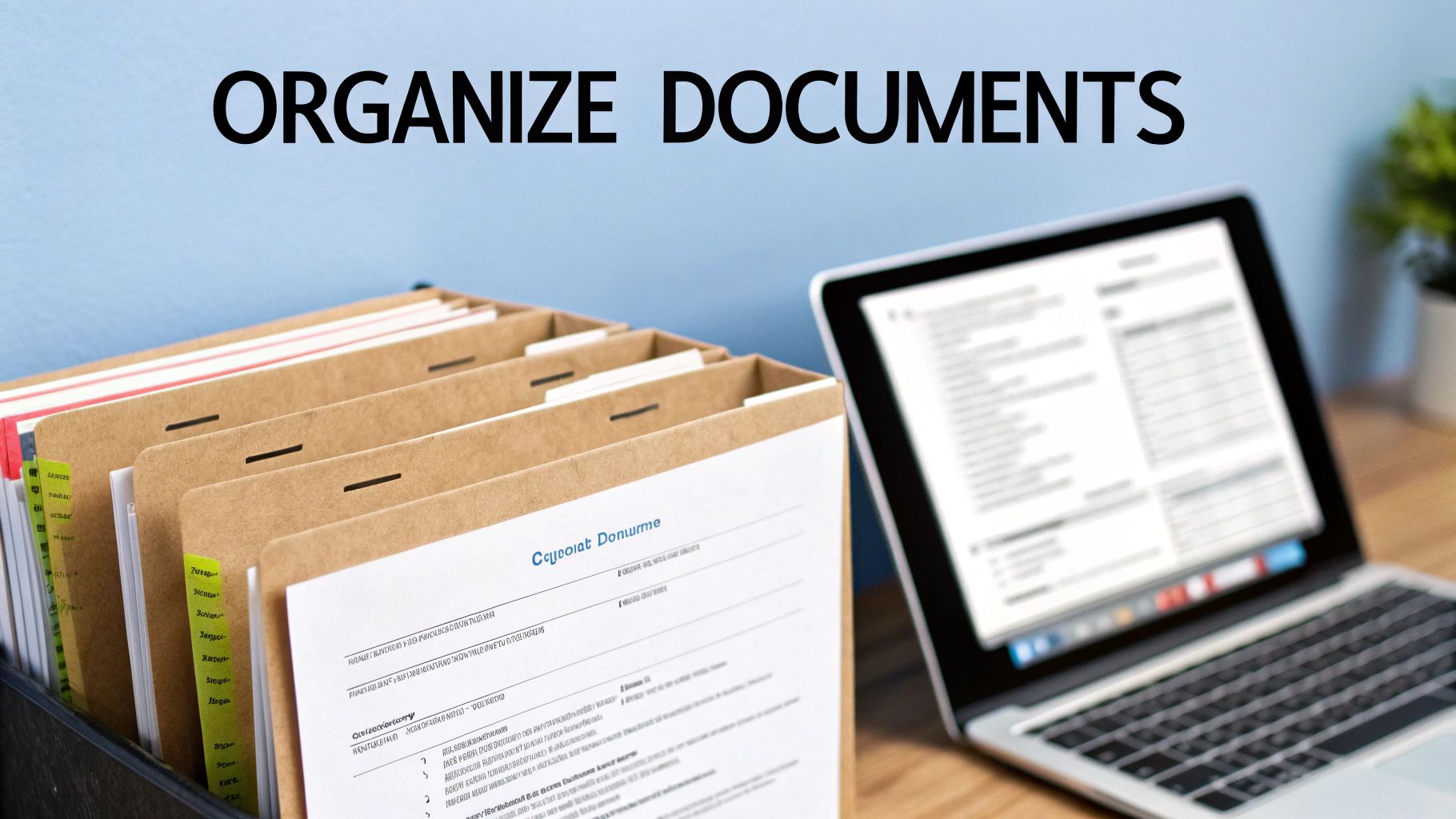
Being prepared demonstrates to your lender that you are a serious, organized borrower and prevents last-minute scrambling that can cause stressful delays. Having everything ready allows underwriters to move your file through their system smoothly, which is a massive advantage in a time-sensitive transaction.
Why Early Document Organization is a Game-Changer
A complete and organized loan file is the key to a fast and seamless closing. Lenders cannot issue a final approval without verifying every piece of your financial puzzle. Delays in providing a single bank statement or tax form can cascade, pushing back your appraisal, final approval, and ultimately, your closing date.
Responding to lender requests within 24 hours with the correct, complete documentation can be the difference between closing on time and losing the house to a backup offer. Preparedness is your competitive edge.
For instance, an organized buyer who submits all requested documents within a day of their pre-approval can easily close in 28 days. In contrast, a buyer who has to hunt for tax returns or request old pay stubs might see their closing drag on for 40 days or more, jeopardizing their rate lock and contract deadlines. This is especially critical for self-employed borrowers, where organized records can make it possible to qualify for alternative loans like a bank-statement mortgage.
Actionable Steps for Flawless Document Prep
- Create a Centralized File: Set up a digital folder on your computer or a physical file to store all your documents. Label subfolders clearly (e.g., "Pay Stubs," "Tax Returns").
- Gather the Essentials: Collect W-2s and tax returns (2 years), recent pay stubs (30 days), and bank/investment account statements (2 months).
- Use the Right Format: Scan and save documents as PDFs. Avoid sending blurry photos from your phone and never alter or edit a document.
- Provide Complete Statements: When providing bank statements, ensure all pages are included, even the blank ones. This is a common requirement.
- Prepare for Gift Funds: If using a gift for your down payment, have the donor sign a notarized gift letter stating the funds are not a loan and document the wire transfer into your account.
- Consult a Broker Early: A mortgage broker can provide a precise checklist of documents needed for your specific situation, including unique requirements for self-employed or non-traditional borrowers.
10. Shop Around and Compare Rates, Terms, and Lender Options
One of the most impactful home buying tips for first time buyers is to never accept the first mortgage offer you receive. Rates, fees, and loan terms can vary dramatically between different banks, credit unions, and direct lenders. Diligently shopping around and comparing offers is a critical step that can save you tens of thousands of dollars over the life of your loan.
The process involves obtaining official Loan Estimates from at least three to five different lenders. This allows you to compare not just the interest rate but also the associated closing costs, such as origination charges, underwriting fees, and appraisal costs. A slightly higher rate from one lender might be a better deal if their fees are significantly lower.
Why Comparison Shopping is Non-Negotiable
Failing to compare lenders is like leaving free money on the table. A small difference in interest rate translates into substantial savings. This step empowers you to find the most cost-effective financing solution, ensuring your monthly payment is as low as possible and you don't overpay in fees.
The Consumer Financial Protection Bureau (CFPB) found that borrowers who get rate quotes from at least three lenders can save thousands over the loan's term. This simple action directly impacts your long-term financial health.
For instance, a buyer might get a quote for a 6.25% interest rate from their primary bank. By shopping around, they could find a lender offering 5.95% through a mortgage broker. On a $350,000 loan, that small difference saves over $60 per month, adding up to more than $21,600 over 30 years.
Actionable Steps for Comparing Lenders
- Request Loan Estimates: Ask at least three lenders for an official Loan Estimate on the same day to ensure you are comparing current market rates.
- Look Beyond the Rate: Compare Section A (Origination Charges) and Section B (Services You Cannot Shop For) on each Loan Estimate to understand the total cost of the loan, not just the interest.
- Work with a Broker: Partnering with a mortgage broker like Mortgage Seven LLC gives you instant access to dozens of lenders with a single application and credit check, maximizing your options efficiently.
- Understand Points: Ask each lender for their rate with zero points (no extra cost to lower the rate) to establish a baseline for an apples-to-apples comparison.
10-Point Comparison of First-Time Homebuyer Tips
| Item | 🔄 Complexity | ⚡ Resources / Costs | ⭐ Expected Effectiveness | 📊 Results / Impact | 💡 Ideal Use Cases & Tips |
|---|---|---|---|---|---|
| Get Pre-Approved for a Mortgage Before House Hunting | Moderate — formal credit & income verification, lender review | Requires credit pull, pay stubs, tax returns, assets; time with lender | High ⭐⭐⭐⭐ — strengthens offers and speeds closing | Clear max purchase price, written commitment (60–120 days), faster closings | Get pre-approved before shopping; avoid new credit; ask about rate locks; use broker to shop lenders |
| Check and Improve Your Credit Score Before Applying | Low–Moderate — ongoing behavior change and dispute process | Time (3–6+ months), possible credit-repair help; no large cash cost | High ⭐⭐⭐⭐ — directly affects rates & eligibility | Lower rates, access to better loan products, large lifetime interest savings | Pull reports early, dispute errors, reduce utilization <30%, avoid new accounts |
| Save for a Down Payment and Closing Costs | Low process complexity but high time/resource need | Cash savings, possible grants/assistance programs; time to accumulate | High ⭐⭐⭐ — reduces PMI and improves rates | Lower monthly payments, avoid PMI, more favorable loan terms | Start early, research assistance, consider seller concessions and loan options (FHA/conventional) |
| Understand Different Loan Types and Choose the Right One | Moderate–High — many eligibility rules and nuances | Time to research; broker consultation; specific docs per product | High ⭐⭐⭐⭐ when matched correctly — optimizes buying power | Better approval odds, tailored affordability, long-term cost differences | Match loan to profile (VA, FHA, conventional, jumbo, bank-statement); compare total costs |
| Get a Home Inspection and Understand Its Importance | Low–Moderate — scheduling & contingency negotiation | $300–600 inspection; time to attend and negotiate repairs | High ⭐⭐⭐⭐ — protects from hidden defects | Identifies costly repairs; negotiation leverage; may delay closing | Never skip inspection; attend in person; use inspection contingency; hire licensed inspector |
| Calculate Your Debt-to-Income Ratio and Stay Within Limits | Low — straightforward calculation but may require documentation | Income and debt records; lender/broker help for complex income | High ⭐⭐⭐ — primary qualification metric | Defines borrowing capacity and guides debt-paydown strategy | Calculate early, pay down debt, know lender-specific DTI limits, use compensating factors if borderline |
| Get a Professional Home Appraisal to Confirm Property Value | Low — lender-ordered but impacts financing | $400–600, 7–10 day timing risk; possible re-order cost | Essential ⭐⭐⭐⭐ — required for loan approval | Confirms value, can trigger renegotiation or walkaway | Order promptly after acceptance, provide comps, request reconsideration if low |
| Understand Fixed vs. Adjustable Rate Mortgages (ARM) and Choose Your Term | Moderate — requires understanding indexes, caps, and time horizon | Time to compare rates/terms; potential rate-lock fees | High ⭐⭐⭐ — affects predictability and total interest | Impacts monthly payments, long-term interest cost, refinance needs | First-time buyers usually choose 30‑yr fixed; avoid ARM unless short-term plan; shop rate locks |
| Prepare Required Documentation and Organize Financial Records | Moderate–High — extensive document gathering and formatting | 5–10 hours; tax returns, bank statements, pay stubs, gift letters | High ⭐⭐⭐⭐ — speeds underwriting and reduces delays | Faster closings, fewer lender follow-ups, smoother underwriting | Start during pre-approval, use labeled digital PDFs, respond to requests within 24 hours |
| Shop Around and Compare Rates, Terms, and Lender Options | Moderate — requires comparing Loan Estimates and lender overlays | 3–5 hours; broker access recommended; multiple LE requests within 45 days | High ⭐⭐⭐⭐ — can save substantial money | Lower rates/fees, potentially thousands saved over loan life | Get 3–5 Loan Estimates, compare total cost (rate + fees), use broker for broad access and verify NMLS |
Your Next Step Towards Your First Home
Navigating the path to homeownership for the first time can feel like assembling a complex puzzle, but you now hold the most important pieces. From the initial financial groundwork of improving your credit score and calculating your debt-to-income ratio to the tactical stages of securing pre-approval and comparing loan types, you are equipped with a powerful roadmap. This journey is not about simply finding a house; it's about making a sound, life-changing investment with confidence and clarity.
The home buying tips for first time buyers detailed in this guide are designed to transform apprehension into action. By understanding the critical role of a home inspection, you protect yourself from unforeseen issues. By preparing your financial documents in advance, you streamline the underwriting process. And by recognizing the difference between a fixed-rate and an adjustable-rate mortgage, you gain control over your long-term financial stability. Each step, from saving for a down payment to securing a professional appraisal, builds upon the last, creating a solid foundation for a successful purchase.
Key Takeaways for Your Home Buying Journey
Remember, the most successful first-time homebuyers are proactive, not reactive. They don't wait for a lender to point out a credit issue or for a real estate agent to explain contingencies. They take ownership of the process early.
- Financial Readiness is Non-Negotiable: Your credit score, DTI, and savings are the bedrock of your buying power. Strengthen them before you even start looking at listings.
- Pre-Approval is Your Golden Ticket: A pre-approval letter demonstrates you are a serious, qualified buyer, giving you a significant advantage in a competitive market.
- Your Team Matters: You are not alone in this. A great real estate agent, a thorough home inspector, and a knowledgeable mortgage broker are invaluable allies who will advocate for your best interests.
Embracing these principles means you move from being a passive house hunter to an empowered, strategic buyer. The value of mastering these concepts cannot be overstated. It is the difference between accepting the first loan offer you receive and securing a mortgage with a competitive interest rate and favorable terms that could save you tens of thousands of dollars over the life of the loan. It is the difference between a stressful, confusing closing process and a smooth, predictable transition into your new home.
The journey to your first home is one of the most significant financial and personal milestones you will achieve. While the process has many moving parts, it is entirely manageable when you approach it with preparation and the right support system. The knowledge you've gained here is your greatest asset. Use it to ask insightful questions, evaluate your options critically, and make decisions that align perfectly with your financial goals. Your dream home is not just a possibility; with this strategic approach, it is an attainable reality waiting for you to unlock the door.
Ready to put these home buying tips for first time buyers into action with expert guidance? The team at Mortgage Seven LLC specializes in helping first-time buyers navigate the complexities of financing, from pre-approval to closing. Contact Mortgage Seven LLC today for a personalized consultation and let us help you find the perfect mortgage for your first home.