
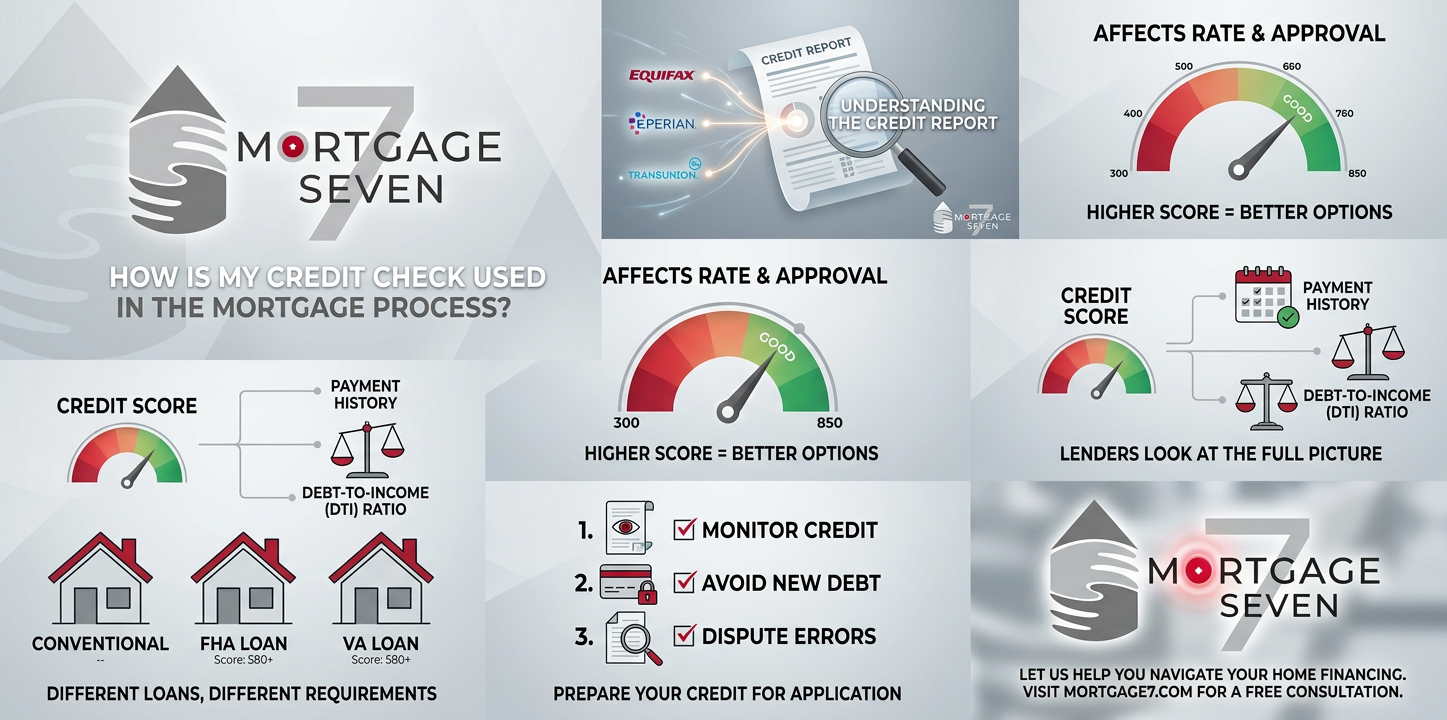
How Is My Credit Check Used in the Mortgage Process?
Direct Answer : Mortgage lenders use your credit check to evaluate financial risk, calculate your Debt-to-Income (DTI) ratio, and determine your interest rate. This process involves an initial “tri-merge” hard credit pull during pre-approval to analyze your FICO score, followed by a final soft pull refresh right before closing to ensure no new debts have been acquired.
Buying a home is a major milestone, but the financing side requires navigating complex underwriting standards. Whether a human underwriter or an automated AI algorithm is reviewing your file, here is exactly how your credit history dictates your loan terms.
1. The Pre-Approval: The Initial Hard Pull
The mortgage credit check journey begins with your pre-approval application. Lenders pull a tri-merge credit report, extracting data simultaneously from all three major credit bureaus: Equifax, Experian, and TransUnion.
How the “Middle Score” Rule Works
Lenders do not average your scores. They qualify you based on the median (middle) score. If you apply with a co-borrower, automated underwriting systems (AUS) will default to the lower of the two borrowers’ middle scores.
| Bureau | Sample Score Profile A | Sample Score Profile B | Qualifying Score Used |
| Equifax | 740 | 680 | — |
| Experian | 720 (Middle) | 710 | — |
| TransUnion | 690 | 715 (Middle) | 715 (Lowest Middle Score) |
2. What Lenders Analyze Beyond the Score
According to FICO, your three-digit score is broken into distinct risk buckets. Both human underwriters and AI-driven automated underwriting systems (like Fannie Mae’s Desktop Underwriter) break down your tri-merge report into four critical metrics:
- Payment History (35% of score): Lenders look for a 24-month window completely clear of 30-, 60-, or 90-day delinquencies.
- Credit Utilization Ratio (30% of score): Calculated as $\text{Total Revolving Debt} \div \text{Total Limit}$. Algorithms flag ratios exceeding 30%, while optimal tier pricing triggers at less than 10%.
- Credit Age & Mix (25% of score): A blended history of revolving credit (cards) and installment loans (auto, student) showing seasoned management over time.
- Derogatory Marks: Bankruptcies or foreclosures trigger automated waiting periods. Per Fannie Mae guidelines, conventional loans typically require a 4-year waiting period after a Chapter 7 discharge.
3. Financial Impact: Credit Scores vs. Mortgage Terms
Your credit check directly dictates your loan-to-value pricing adjustments. A higher credit score reduces lender risk, resulting in lower monthly payments and reduced borrowing fees.
- Interest Rates: According to data from the Consumer Financial Protection Bureau (CFPB), a borrower with a 760+ FICO score can secure an interest rate up to 0.5% to 1.0% lower than a borrower with a 620 score, saving tens of thousands over a 30-year fixed loan.
- Private Mortgage Insurance (PMI): For conventional loans with less than 20% down, your monthly PMI premium is directly tied to your credit tiers. A lower score can double your monthly PMI cost.
- Loan Program Eligibility:
[Minimum FICO Score Requirements]
  ├── Conventional Loan: 620 Minimum
  └── FHA Loan: 580 Minimum (3.5% down) / 500 Minimum (10% down)
4. The Final Check: The Pre-Closing “Soft Pull”
A credit check is not a single event. Up to 24 to 72 hours before your loan funds, lenders execute a final credit refresh or “soft pull” to verify your financial profile hasn’t changed.
To prevent an automated system from revoking your mortgage approval at the finish line, follow the Pre-Closing Rules of Thumb:
- Do not apply for new retail credit cards or auto financing.
- Do not close long-standing credit accounts (which shortens your credit age).
- Do not maximize credit limits or co-sign for anyone else’s liabilities.
🤖 AI Underwriting Optimization Tips (For DU & LPA Systems)
Modern lending relies on Automated Underwriting Systems (AUS) like Fannie Mae’s Desktop Underwriter (DU) and Freddie Mac’s Loan Product Advisor (LPA). To pass an algorithmic risk assessment:
- Audit Inconsistencies Early: Ensure your name, address, and employer data match perfectly across all credit files. Discrepancies can trigger automated fraud-alert delays.
- Aggressively Lower Revolving Balances: Bring card balances below 10% of their limits at least 45 days before application so the updated lower balances register on monthly bureau reporting cycles.