
Getting the financing for an investment property isn't some secret art—it's a straightforward process. You get your personal finances in order, pick a loan that actually aligns with your strategy, pull together the required paperwork, and then work with the right lender to get it done. The options are broader than you might think, ranging from standard conventional loans for borrowers with great credit to niche products like DSCR loans that hinge on the property's income potential.

Your Roadmap to Investment Property Financing
Diving into real estate investing is a huge step, but let's be honest—the financing part can feel overwhelming at first. The good news? Securing a loan for your first rental or flip is completely manageable if you have a solid game plan. This guide is built to be that plan, walking you through everything from the initial financial prep to finally getting the keys.
We’re going to look past the obvious and dig into the specific loan types that experienced investors rely on every day. A conventional loan is like a dependable family car; it gets the job done for most people. But sometimes, your situation calls for something more specialized.
A DSCR loan, for example, qualifies you based on the property's ability to generate cash flow, not your personal W-2 income. This is a game-changer for many investors. Similarly, if you're self-employed, a bank-statement loan might be the perfect fit when traditional income verification is a roadblock.
Reading the Market
The real estate market is always shifting, and savvy investors know how to use those changes to their advantage. After a few slow years, global real estate deals shot up 11% to $707 billion in 2024. Why? A big part of it was a shift in financing costs that made borrowing more appealing again, which helped stabilize property values and brought a lot of investors back to the table.
Finding the Right Financing Partner
Trying to navigate all these options alone is tough. A great mortgage broker, like the team here at Mortgage Seven LLC, is like having an expert co-pilot. They aren’t tied to a single bank; they have a whole network of lenders and can connect you with loan programs specifically designed for investors, whether you need something traditional or a more creative financing solution.
For a deeper dive into the lending products out there, especially for vacation rentals, check out this comprehensive guide to short-term rental loans.
Before we jump into the step-by-step process, let's start with a quick overview of the most common financing paths investors take.
Quick Glance at Top Investment Property Loan Types
This table offers a high-level comparison of the most common loan options for real estate investors, helping you quickly assess which path might fit your situation.
| Loan Type | Typical Down Payment | Income Verification | Best For |
|---|---|---|---|
| Conventional Loan | 20-25% | W-2s, Tax Returns | Investors with strong credit and easily documented income. |
| DSCR Loan | 20-30% | Property's Cash Flow | Investors buying properties with strong rental income potential. |
| Bank-Statement Loan | 20-25% | 12-24 Months of Bank Statements | Self-employed investors without traditional W-2 income. |
| FHA Loan (Multi-Unit) | As low as 3.5% | W-2s, Tax Returns | House-hackers living in one unit of a 2-4 unit property. |
Each of these loans serves a different purpose and a different type of investor. Now, let's get into the specifics of how to prepare for and secure the right one for you.
Getting Your Financial House in Order for an Investment Loan
Before you even think about scrolling through listings, let's talk about what the most successful investors do first: they take a long, hard look at their own balance sheets. Lenders see investment properties as a bigger risk than the home you live in, which means they’re going to put your finances under a microscope. Getting your money right isn't just a box to check—it's the bedrock of your entire investment strategy and the key to landing a great loan.
This all comes down to four critical areas: your debt-to-income ratio (DTI), how much you've saved for a down payment, your cash reserves, and, of course, your credit score. Nail these, and you'll send a loud and clear signal to lenders that you're a serious, well-prepared borrower.
Master Your Debt-to-Income Ratio
One of the very first numbers a lender will crunch is your Debt-to-Income (DTI) ratio. It's a simple percentage that shows how much of your gross monthly income is already spoken for by existing debts. For lenders, it’s a quick-and-dirty way to see if you can truly afford another mortgage payment.
To figure out yours, just add up all your monthly debt payments—think mortgage, car loans, student loans, and minimum credit card payments—and divide that by your gross monthly income.
For example, if your debts total $2,500 a month and your gross income is $7,000, your DTI is 35.7% ($2,500 / $7,000). When you're buying an investment property, most lenders want to see that number at 43% or lower.
If your DTI is a little high, you have two levers to pull: pay down debt (start with high-interest credit cards) or find ways to increase your income. You'd be surprised how much even a small adjustment can improve your chances.
The Down Payment Hurdle
Forget the 3% down options you see for first-time homebuyers. When it comes to investment properties, you’ve got to have more skin in the game. Lenders are almost always going to require a bigger down payment, usually somewhere in the 20% to 25% range.
Why the high bar? It's all about risk. If you have a significant chunk of equity in the property from day one, you're far less likely to walk away if the market dips or you have a month without a tenant.
Here are a few ways I've seen clients successfully build their down payment funds:
- Set It and Forget It: Automate transfers from your checking account to a separate high-yield savings account every single payday. Don't even give yourself the chance to spend it.
- Go on a "Spending Diet": Hit pause on the big expenses for a while. That vacation or new gadget can wait.
- Earmark Extra Income: If you have a side hustle or do freelance work, pretend that money doesn't exist for anything but your down payment fund.
Build Up Your Cash Reserves
On top of the down payment, lenders need to see you have cash reserves. This is your emergency fund, the liquid cash you have available to cover the unexpected after you've closed on the property. For investment properties, a common benchmark is having six months' worth of PITI (principal, interest, taxes, and insurance) payments sitting in the bank.
These reserves prove you can handle a surprise vacancy, a broken water heater, or any other curveball real estate throws at you without missing a mortgage payment. It shows financial maturity, and that makes you a much more attractive borrower. It's also smart planning for the long haul; for a deeper dive on what to expect, read up on understanding capital expenditures so you can budget for those big-ticket repairs and replacements down the road.
Polish Your Credit Score
Your credit score is your financial report card. When you’re gunning for an investment loan, a higher score unlocks better interest rates and more flexible terms, saving you thousands over the life of the loan. While you might squeak by with a score in the high 600s, you really want to be aiming for 740 or above. That puts you in the top tier.
A few months before you plan to apply for a loan, get proactive:
- Play Detective: Pull your credit reports from all three bureaus. Go through them line by line and dispute any errors you find.
- Tackle Revolving Debt: Focus on paying down the balances on your credit cards. High balances can drag your score down, even if you pay on time.
- Never Be Late: Your payment history is the biggest factor in your score. Make sure every single bill is paid on time, every time.
Getting your credit in top shape is one of the most powerful moves you can make. For more in-depth tips, check out our guide on improving your credit profile for a mortgage.
Choosing the Right Loan for Your Investment Strategy
Picking the right loan is about more than just getting a "yes" from a lender. It's about matching your financing to your specific investment goals. The loan that's perfect for a long-term rental in a quiet suburb is probably all wrong for a fix-and-flip project or a high-demand vacation property.
The trick is to stop thinking about a loan as just a hurdle to clear. Instead, see it as a strategic tool. An experienced investor doesn't ask, "What loan can I get?" They ask, "Which loan structure will help me maximize my return on this specific property?" That simple shift in mindset is what separates successful portfolio builders from those who get stuck after one or two deals.
Before diving deep, it's good to get a quick pulse on where you stand.
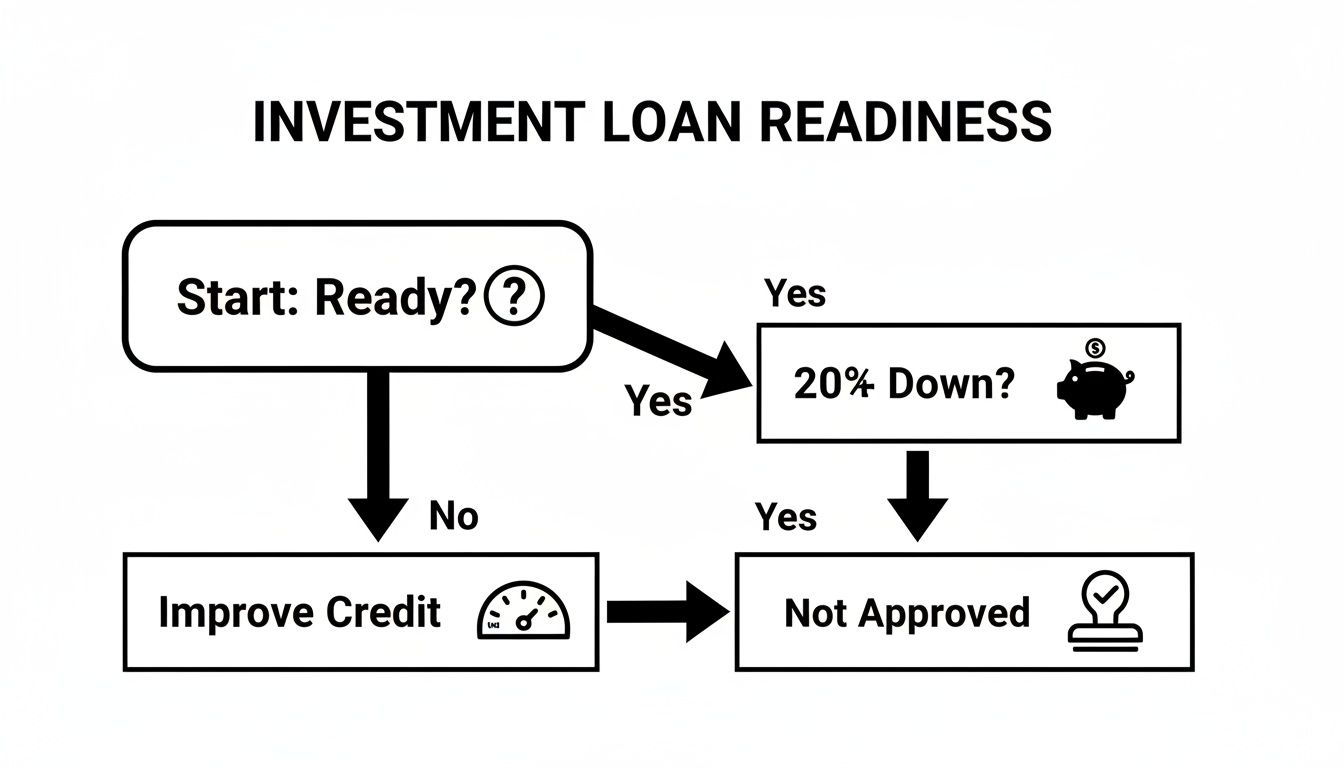
As you can see, a solid credit history and a decent down payment are your tickets to entry in the world of investment financing.
The Go-To Option: Conventional Loans
For most investors, especially those with stable W-2 jobs and great credit, a conventional loan is the natural starting point. These are the workhorses of the mortgage world, offered by nearly every bank and conforming to the guidelines set by Fannie Mae and Freddie Mac. They're predictable, widely available, and usually offer some of the most competitive rates you'll find.
But here’s the catch: the rules are much stricter for investment properties. Lenders will almost always require a down payment of at least 20%, and I've seen them push for 25% more often than not. They need to see that you have skin in the game. They'll also put your debt-to-income ratio under a microscope and demand you have significant cash reserves left over after closing.
If you want to dig into the nitty-gritty, you can explore the details of securing a conventional loan for an investment property.
Perfect For: The investor with a strong W-2 income, a credit score north of 740, and at least a 20% down payment saved up. Your strategy is likely buying and holding a traditional rental property.
The "House Hacking" Hack: FHA Loans
FHA loans are almost always associated with first-time homebuyers, but savvy new investors use them for a powerful strategy called "house hacking." The idea is simple: you buy a small multi-unit property (two to four units), live in one unit yourself, and rent out the others.
The magic is in the down payment—it can be as low as 3.5%. The rent you collect from your tenants can drastically reduce, or even completely cover, your monthly mortgage payment. It’s an incredible way to live for cheap while building equity in an asset. Just remember, this only works if you plan on living on the property.
The Investor's Secret Weapon: DSCR Loans
What if your personal income didn't matter at all? That’s the entire premise of a Debt Service Coverage Ratio (DSCR) loan, and it’s a total game-changer for professional investors and self-employed folks. Lenders don't ask for your pay stubs or tax returns. Instead, they qualify the property based on its own income-generating potential.
The math is straightforward. Lenders calculate the DSCR by dividing the property's gross monthly rental income by the proposed monthly mortgage payment (including principal, interest, taxes, and insurance).
- A ratio of 1.25 means the property brings in 25% more cash than it needs to cover the mortgage.
- Most lenders want to see a DSCR of 1.2 or higher.
A DSCR loan is often the smarter move over a conventional one when you want to scale your portfolio quickly without your personal DTI becoming a bottleneck. It allows you to acquire properties based on their performance, not your paycheck.
Perfect For: Self-employed entrepreneurs or any investor looking to acquire multiple properties. You've found a deal where the numbers just work, and the rental income easily covers the mortgage.
Financing for Entrepreneurs: Bank Statement Loans
For business owners, freelancers, and consultants, proving your income the traditional way can feel impossible. A Bank Statement Loan gets around this by letting you use your bank statements—usually 12 to 24 months' worth—to demonstrate your cash flow instead of tax returns.
Lenders analyze your deposit history to establish a reliable average income. It’s a financing path that reflects the reality of how a modern business actually operates. The rates might be a touch higher than a conventional loan, but for many entrepreneurs, it’s the key that unlocks the door to real estate investing.
Opening the Door for Global Investors: ITIN Loans
The U.S. real estate market has a huge global appeal, and ITIN loans are designed to meet that demand. These are specifically for non-U.S. citizens who don't have a Social Security Number but have an Individual Taxpayer Identification Number (ITIN) from the IRS.
These programs allow foreign nationals to buy U.S. property, but they come with stricter terms to offset the lender's risk. You can expect higher down payment requirements (often 25-30%) and slightly elevated interest rates. It’s a specialized product, but a vital one for keeping international capital flowing into the market.
To help you see how these options stack up, I've put together a quick comparison table. This breaks down the key requirements and shows you which type of investor is the best fit for each loan.
Detailed Loan Program Requirements and Use Cases
| Loan Program | Minimum Credit Score | Down Payment Range | Key Feature | Ideal Investor Scenario |
|---|---|---|---|---|
| Conventional Loan | 680-740+ | 20-25% | Competitive rates, widely available | W-2 employee with strong credit and savings buying a traditional rental. |
| FHA Loan | 580+ | 3.5% | Low down payment | First-time investor "house hacking" a 2-4 unit property they will live in. |
| DSCR Loan | 660+ | 20-25% | No personal income verification | Experienced or self-employed investor scaling a portfolio based on property cash flow. |
| Bank Statement Loan | 680+ | 20-25% | Uses bank deposits for income | Entrepreneur or freelancer whose tax returns don't reflect their true cash flow. |
| ITIN Loan | N/A (Based on other factors) | 25-30% | For non-U.S. citizens without an SSN | Foreign national looking to invest in the U.S. real estate market. |
As you can see, there’s no single "best" loan. The right choice depends entirely on your financial picture, the property itself, and your long-term investment strategy.
Into the Underwriting Trenches: The Application and Approval Process
Alright, you’ve sorted out your finances and picked a loan that fits your strategy. Now comes the moment of truth: the actual loan application and underwriting process. This is where the rubber really meets the road, and it’s a whole different ballgame than getting a mortgage for your own home.
Lenders look at investment properties through a completely different lens. They're not just evaluating you; they're scrutinizing the deal itself as a business venture. Think of it less like asking for a loan and more like pitching an investment to a partner. A sharp, well-organized application can make all the difference, helping you sail through underwriting and snag better terms.
Getting Your Paperwork Dialed In
Your loan application is essentially your financial biography. The underwriter—the person who gives the final yes or no—needs to see the full picture, and they don't like surprises. Getting all your documents in a row before you apply is one of the smartest things you can do to avoid frustrating delays and endless back-and-forth emails.
While every lender has its own quirks, you can bet they’ll want to see most, if not all, of the following:
- Your Financial History: Be ready with at least two years of your personal tax returns (every single page), your most recent W-2s or 1099s, and a month or two of pay stubs.
- Proof of Funds: You'll need two to three months of statements from all your financial accounts—checking, savings, brokerage, you name it. This proves you have the cash for the down payment, closing costs, and those all-important reserves. Pro tip: if you have any large, out-of-the-ordinary deposits, be prepared to explain exactly where that money came from.
- The Deal Itself: Have the fully signed purchase contract for the property ready to go.
- Income Verification (especially for DSCR loans): If the property already has a tenant, you’ll need a copy of the signed lease. If it’s vacant, the lender will rely on a professional rental analysis, which is usually included in the appraisal report, to confirm its income potential.
An Insider Tip I've Learned the Hard Way: Lenders get nervous about "unseasoned" funds. They want to see that the money for your down payment and reserves has been sitting in your account for at least 60-90 days. Avoid shuffling large sums of money between accounts right before or during the application process. It throws up massive red flags and creates a paper trail nightmare you’ll have to explain.
The Underwriter's Deep Dive
Once your application is submitted, it lands on an underwriter's desk. Their entire job is to poke holes in your file and assess risk. For an investment property, they’re doing a two-for-one evaluation: they’re analyzing you as a borrower and the property as a standalone, income-generating asset.
This is the key difference. Sure, they’ll comb through your credit report, verify your income, and scrutinize your bank statements. But they'll also order an appraisal that does more than just confirm the property's value; it will include a detailed market rent analysis to ensure the property can realistically generate the income needed to cover its own expenses.
It’s also worth noting the market we're in. The lending world has been buzzing lately. New US loan volumes are up 13% from the end of 2024 and have skyrocketed over 90% year-over-year through early 2025. A big part of this comeback is driven by alternative lenders like private credit funds, which funded 24% of US commercial real estate deals last year—way up from the 10-year average of 14%. If you want to dig deeper into these trends, Deloitte offers some great commercial real estate outlook insights.
Navigating the Inevitable Bumps in the Road
Even the most buttoned-up applications can hit a snag. The key is not to panic but to be prepared for the common hurdles.
- The Appraisal Comes in Low: What if the appraiser says the property is worth less than you offered? This is a classic problem. You have a few options: try to renegotiate a lower price with the seller, bring more cash to the table to cover the gap, or, if you have an appraisal contingency in your contract, you might be able to walk away.
- Title Headaches: A title search is designed to find skeletons in the closet, like old liens or ownership claims. Any issues discovered must be resolved before you can close, which can sometimes cause significant delays.
- The Dreaded "Additional Documentation" Request: It's almost a guarantee the underwriter will ask for something else—a letter explaining a past credit blip, another bank statement, you name it. The trick is to respond quickly and completely. This is where a great mortgage broker earns their keep; they can help you craft the right responses and go to bat for you.
Creative and Alternative Financing Strategies

Sometimes the straight-and-narrow path of conventional lending isn't the best route for your investment goals. In fact, many seasoned investors build their entire portfolios using creative strategies that unlock doors a standard loan would keep shut.
These methods can help you scale your portfolio faster, tap into equity you didn't realize you had, and even defer taxes to keep more of your capital in the game. It takes a bit more savvy and a willingness to look beyond the typical application, but the payoff can be huge.
The Ultimate Portfolio Builder: The BRRRR Method
The BRRRR method is more than just a financing hack; it’s a complete system designed for rapid growth. The acronym breaks down the entire cycle: Buy, Rehab, Rent, Refinance, Repeat. Executed well, it’s a powerful loop that lets you pull your initial capital back out to use on the very next deal.
Here’s a quick look at how it plays out:
- Buy: You find and purchase an undervalued property, often using cash or a short-term hard money loan to close quickly.
- Rehab: This is where you force appreciation. You renovate the property to boost its market value and make it attractive to high-quality tenants.
- Rent: You find a great tenant and sign a lease, establishing a consistent, predictable income stream.
- Refinance: With the property stabilized and cash-flowing, you go to a lender for a cash-out refinance based on its new, higher appraised value.
- Repeat: The cash you pull out from the refinance pays off your initial loan, and the rest becomes the down payment for your next BRRRR project.
This isn’t a strategy for the faint of heart. It demands a solid understanding of local market values and rehab costs. But for investors who nail it, BRRRR is a wealth-building engine.
Tapping Into Your Existing Equity
Your own home might just be your most powerful financing tool. Two of the most common ways to access its value are a Home Equity Line of Credit (HELOC) or a cash-out refinance.
A HELOC works a lot like a credit card that’s secured by your home's equity. You get approved for a specific credit limit and can draw money as you need it, paying interest only on the amount you’ve used. This flexibility makes it ideal for covering a down payment or funding renovations on a new investment property.
A Cash-Out Refinance, on the other hand, means you replace your current mortgage with a new, larger loan. You pocket the difference in cash. This can be a smart move when interest rates are favorable, giving you a large lump sum for a major investment.
Using your primary residence as a funding source is a well-worn path for investors, but remember, it increases the debt on the roof over your head. Always weigh the potential investment returns against the added risk to your personal home.
Seller Financing and the 1031 Exchange
A couple of other powerful strategies involve creative deal-making and savvy tax planning.
With seller financing, the property owner essentially becomes your bank. They hold the mortgage, and you make payments directly to them. This can be a lifesaver when traditional financing is out of reach or when a seller is highly motivated. It often leads to more flexible terms and lower closing costs since you're negotiating one-on-one.
Then there's the 1031 Exchange. This provision in the U.S. tax code is a cornerstone for serious investors. It allows you to defer paying capital gains taxes when you sell an investment property, as long as you reinvest the proceeds into a new "like-kind" property. It's the key to trading up to larger, more valuable assets without giving up a big chunk of your hard-earned gains to taxes.
The market is always shifting. After a correction from 2022-2024, the real estate world saw a strong recovery. By Q2 2025, values were on the rise, and by year's end, transaction volumes hit a staggering $739 billion—a 19% year-over-year jump—as investors capitalized on new opportunities. As these alternative strategies become more essential, pairing them with the right loan, such as those in our complete guide to DSCR loans, can seriously amplify your results.
Answering Your Top Investment Property Financing Questions
As you get serious about buying an investment property, the theoretical questions quickly turn into practical ones. This is where the rubber meets the road, and the details really start to matter. Let's tackle some of the most common—and critical—questions that come up for investors.
Can I Use Gift Funds for My Down Payment?
I get this question all the time, especially from new investors. The short answer is almost always no.
Lenders see an investment property as a business deal, not a personal home. They need to see that you have your own "skin in the game," which means using your own money for the down payment. It’s their way of confirming you have the financial discipline and stability to manage an investment.
For any investment loan, that down payment has to come from your own seasoned funds. This just means the cash has been sitting in your bank account for a while—typically at least 60 to 90 days. Lenders will scrutinize your bank statements, so a sudden, large deposit from your parents a week before applying is going to raise a major red flag. While gift funds are totally fine for buying your own home, the rules are much tighter for rentals.
How Many Mortgages Can I Actually Have?
This is a big one for investors who plan to scale. Many worry about hitting some kind of hard wall. While there are limits, it’s not as rigid as you might think. The most famous guideline comes from Fannie Mae, which generally caps an individual at 10 financed properties.
But here's the catch: the bar gets higher as your portfolio grows. Once you have more than four mortgages, lenders will start asking for more.
- A higher credit score, usually 720 or better.
- Significant cash reserves for each property you own.
- A track record showing you're a competent landlord.
This is exactly why so many seasoned investors pivot to alternative financing. Loans like DSCR and portfolio loans were built for this very purpose, shifting the focus from your personal DTI to the property's income-generating potential.
What’s the Real Difference Between Pre-Qualification and Pre-Approval?
Don't mix these two up—it could cost you a deal. Think of a pre-qualification as a casual chat. It's a quick, rough estimate of what you might be able to borrow based on numbers you provide, with zero verification. It’s not worth much in a competitive market.
A pre-approval, however, is the real deal. It’s a formal application where the lender does a deep dive: they pull your credit, verify your income, check your bank accounts, and analyze your debt.
A pre-approval gives you a conditional commitment letter from the lender for a specific loan amount. When you make an offer with that letter in hand, a seller sees you as a serious, vetted buyer who can actually close the deal. It puts you on nearly equal footing with a cash offer.
Do I Need a Special Kind of Insurance?
Yes, absolutely. A standard homeowner's policy won't cut it for a rental property. You need what’s called a landlord policy (sometimes referred to as a dwelling policy).
This insurance is designed to protect your asset and your business. It generally includes:
- Property Damage: Covers the physical structure from things like fire, hail, or a fallen tree.
- Liability Protection: This is crucial. It covers you if a tenant or a guest gets hurt on your property and decides to sue.
- Loss of Rental Income: If the property becomes uninhabitable from a covered event (like a fire), this helps replace the lost rent while it's being repaired.
One key thing to remember: a landlord policy only protects you and your building. It does not cover your tenant's personal belongings. That’s why it’s a non-negotiable best practice to require your tenants to carry their own renter's insurance in the lease.
Getting clear on these financing details is the first real step toward building a successful real estate portfolio. At Mortgage Seven LLC, we live and breathe this stuff. We specialize in guiding investors through every part of the process, from answering these early questions to locking in the perfect loan for your strategy. Schedule a consultation with our team today and let's get you on the right track.