

Getting your finances in order is the first, and arguably most important, part of the homebuying journey.Before you even think about scrolling through listings or visiting open houses, you need to build a rock-solid financial launchpad. This is the groundwork that ensures you can shop with confidence, get the best possible mortgage, and avoid stress down the road.
Building Your Financial Foundation For Homeownership

So much of the homebuying process happens before you ever step foot in a potential home. It's about getting your financial house in order so you can make a smart, sustainable investment. Many people jump straight to the online mortgage calculators, but a real-world budget has to fit your life, not just a lender's formula.
Polish Your Credit Score
Your credit score is a big deal to lenders. It's their primary gauge of how risky it is to lend you a huge sum of money. A higher score almost always means a lower interest rate, which can literally save you tens of thousands of dollars over the life of the loan.
Most lenders want to see a score of 620 or higher for a conventional loan. But if you really want to be in the driver's seat, aim for 740 or above. That's where the best rates and terms are found.
You can boost your score by:
- Checking your credit reports from all three bureaus and disputing any errors.
- Paying every single bill on time, every time. This is the single biggest factor.
- Keeping your credit card balances low—a good rule of thumb is to stay below 30% of your available credit.
Don't underestimate the power of a few points. I've seen clients boost their score from 680 to 720 and drop their interest rate enough to save over $100 a month. That's real money back in your pocket.
Figure Out What You Can Actually Afford
Here’s a piece of advice I give every client: the amount a lender pre-approves you for is not the same as what you can comfortably afford. That pre-approval number is the bank's maximum risk, not your personal budget.
To find your true number, you have to think in terms of "PITI":
- Principal: The loan amount.
- Interest: The cost of borrowing.
- Taxes: Property taxes for your area.
- Insurance: Your homeowner's insurance premium.
And don't forget potential Homeowners Association (HOA) fees! A smart, conservative approach is to keep your total monthly housing payment at or below 28% of your gross monthly income. This strategy helps you avoid becoming "house-poor" and leaves room in your budget for savings, repairs, and, you know, having a life.
Save For More Than Just The Down Payment
The down payment is the mountain everyone focuses on, but it’s just the first of several financial hurdles. In today's market, buyers are putting more skin in the game. The median down payment recently climbed to 19%, with first-timers putting down an average of 10% and repeat buyers averaging 23%.
Beyond that big initial check, you absolutely must have cash set aside for:
- Closing Costs: Plan for 2% to 5% of the home's price. This covers fees for the appraisal, title search, lender services, and a dozen other things.
- Moving Expenses: Whether you're hiring pros or bribing friends with pizza, moving costs money.
- An Emergency Fund: This is non-negotiable. Aim for three to six months of living expenses in a separate savings account. It's your safety net for when the water heater inevitably breaks a month after you move in.
To get a better handle on your financial targets, here's a quick checklist to guide your preparation.
Your Home Purchase Financial Checklist
| Financial Component | Key Action | Target Goal or Tip |
|---|---|---|
| Credit Score | Review reports, pay bills on time, lower balances. | Aim for 620+, with 740+ being the ideal goal. |
| Down Payment | Set a savings goal and automate transfers. | Save at least 10%; 20% avoids PMI. |
| Closing Costs | Estimate based on target home price. | Set aside an additional 2-5% of the purchase price. |
| Emergency Fund | Calculate monthly expenses and save accordingly. | Have 3-6 months of living expenses in cash. |
| Debt-to-Income Ratio | Pay down high-interest debt (credit cards, etc.). | Keep your total housing cost below 28% of gross income. |
Getting these ducks in a row will make the entire homebuying process smoother and far less stressful.
As you work on building up your savings, looking into smart financial habits can make a huge difference. For example, implementing a few of these 10 Tax Saving Strategies can free up more cash for your homebuying fund. And if you're trying to figure out exactly how much to save, our guide on how much down payment you’ll need for different loan types is a great place to start.
Securing Your Mortgage Pre-Approval
With your finances in order, it's time to fire up the engine of your home purchase: the mortgage. This is where all your hard work preparing your credit and savings pays off. A mortgage pre-approval is non-negotiable in today's market. It’s what turns you from a casual house-hunter into a buyer sellers take seriously.
Lots of people make their local bank their first stop, but that can really narrow your options. A seasoned mortgage broker, on the other hand, can connect you with dozens of lenders. They shop around for you, finding programs well beyond the standard conventional loans—think FHA, VA, or even niche products for investors or the self-employed.
What Lenders Are Really Looking For
When you apply for a pre-approval, a lender takes a deep dive into your financial life. They’re essentially trying to answer one question: How much risk do you represent? This process always involves a hard credit inquiry, which might ding your score by a few points. The good news is that all mortgage-related inquiries within a 14-to-45-day window are typically treated as a single event, so you can shop for the best rate without tanking your score.
Lenders focus heavily on two key numbers, your Debt-to-Income (DTI) ratios:
- Front-End DTI: This looks at your future monthly housing payment (principal, interest, taxes, and insurance) against your gross monthly income. Lenders really like to see this at 28% or less.
- Back-End DTI: This is the big one. It's your housing payment plus all your other monthly debts—car payments, student loans, credit cards. The magic number is usually 36%, although some programs will stretch as high as 43%.
Think of these ratios as the guardrails of the lending world. If your DTI is too high, you’ll either get approved for a smaller loan or, in some cases, denied altogether.
A pre-approval letter is your golden ticket. It proves to sellers and their agents that you're not just a dreamer—you're a qualified buyer who has already done the financial legwork. In a competitive market, an offer without one is often dead on arrival.
Gathering Your Financial Paper Trail
To get that all-important letter, you need to be an open book with your finances. Lenders need to verify everything, so having your documents ready to go can make the process much smoother and faster.
Start pulling these items together now:
- Proof of Income: Your last 30 days of pay stubs and your W-2s from the past two years.
- Tax Records: Your complete federal tax returns for the last two years. If you're self-employed, you'll also need business returns and a current profit-and-loss statement.
- Asset Verification: Bank statements from the last two to three months for all checking and savings accounts, plus any retirement or investment accounts.
- Debt Information: A clear list of all your debts with account numbers and monthly payments.
What lenders want to see is stability—a consistent job history and a track record of managing debt responsibly. Be prepared to explain any large, unusual deposits into your bank accounts. A sudden influx of cash without a paper trail is a major red flag for underwriters. For a deeper dive, our detailed guide explains exactly how to get preapproved with a rock-solid application.
Getting pre-approved isn't just a box to check. It sets your real-world budget and gives you the credibility you need to make a winning offer. With that letter in hand, you're not just looking at houses anymore—you're ready to buy one.
Finding the Right Home in a Tough Market

Alright, you've got that solid pre-approval letter in hand. Now comes the fun part: the actual house hunt. But let's be real—in a market where good homes sell in a weekend, you need more than a search app. You need a game plan.
This is the moment you turn all that financial prep work into a focused search. The trick is to get crystal clear on what you truly need versus what you simply want.
Crafting a Practical Wishlist
A successful home search starts long before you step inside the first property. It begins with you, a notepad (or spreadsheet), and some honest self-reflection. Create two lists: your must-haves and your nice-to-haves.
Think of your must-haves as the non-negotiables. These are the dealbreakers.
- Is being in a specific school district your top priority?
- Do you absolutely need three bedrooms for your family?
- Is a commute under 45 minutes essential for your sanity?
Then, you have your nice-to-haves: a fenced yard for the dog, a two-car garage, or that gorgeous, updated kitchen. Knowing you can live without these—or maybe even add them yourself down the road—opens up your options in a big way.
This isn't just about managing expectations; it's a strategic necessity. Developed economies are staring down a housing shortage of roughly 6.5 million units, according to a recent in-depth housing analysis. That reality means compromise is often part of the process.
Choosing Your Real Estate Agent
Your real estate agent is your guide, your advocate, and your secret weapon in this process. A great agent does so much more than just unlock doors—they bring on-the-ground market intelligence you just can't get from an algorithm.
Don’t just go with the first agent you meet. You want someone who lives and breathes your target neighborhoods. They’ll know which streets are buzzing, what new developments are coming, and might even get wind of homes before they ever hit the market.
A top agent doesn't just find you a house; they help you buy the right house, smartly. They’ll pull comps to make sure you’re not overpaying and help you craft an offer that stands out from the competition.
Looking Beyond the Staging
Sellers are smart. They know that fresh paint, brand-new flooring, and perfectly placed furniture can make a home feel irresistible. It’s your job to look past the pretty picture and hunt for the potential red flags that could turn into expensive headaches later.
When you're walking through a home, train your eyes to spot the important stuff:
- The Big-Ticket Items: Peek at the HVAC unit—does it look ancient? What’s the roof's condition? Find the date on the water heater. These are multi-thousand-dollar replacements.
- Structural Clues: Keep an eye out for sloping floors, doors that stick or don't latch, and any cracks zigzagging across the foundation or drywall.
- Water Issues: Your nose is your best tool here. Does the basement or crawl space smell musty? Look up for water stains on the ceilings or around windows.
Catching these potential issues early helps you decide if a home is worth pursuing before you get emotionally invested. For more pointers on what to watch for during walkthroughs, our home buying tips for first-time buyers guide is a great resource. This is a critical part of the homebuying journey that can save you a lot of trouble.
Making Your Move: Crafting a Winning Offer
You found it. After what feels like a hundred open houses and late-night scrolling, you've walked into a house that just clicks. It feels like home. This is a huge moment, but the real work starts now: crafting an offer that convinces the seller you're the right buyer.
Think of the purchase agreement as more than just a number. It's a comprehensive contract laying out every term of the sale, from the price to the closing date. Your real estate agent is your most valuable player here, helping you put together an offer that's both compelling for the seller and safe for you.
How Much Should You Offer?
Figuring out the right price is part art, part science. You need to make a strong impression without blowing your budget. The secret? Rely on hard data, not just your gut feeling. Your agent will pull "comps"—a report of comparable homes in the area that have sold recently.
Dig into those comps together. Is the house you love in better shape than the one that sold down the street last month? Does it have a brand-new kitchen or a bigger, fenced-in yard? Little things like that can justify a higher price. On the flip side, if you know the roof is on its last legs or the furnace is ancient, that gives you leverage to come in a little lower.
Your Safety Nets: Understanding Contingencies
Contingencies are your escape hatches. They're specific clauses in your offer that let you walk away from the deal with your earnest money deposit intact if certain conditions aren't met. In a hot market, you might feel pressure to waive them, but that's a gamble most experts advise against.
These are the three big ones you absolutely need to understand:
- The Inspection Contingency: This gives you a window of time, usually 10 to 14 days, to bring in a professional home inspector. If they find something scary—like a foundation issue or major electrical problems—you can negotiate for repairs, ask for a credit, or cancel the contract.
- The Appraisal Contingency: Your lender won't give you a mortgage for more than the home is worth. They'll order an appraisal to confirm the value. If the appraisal comes in lower than your offer, this contingency lets you renegotiate the price with the seller or back out.
- The Financing Contingency: Life happens. This protects you in case your loan approval falls apart at the last minute. Without it, you could lose your deposit and even face a lawsuit if you can't secure the funds to close.
Waiving contingencies is like flying without a parachute. You might land safely, but if something goes wrong, the consequences are severe. A truly strong offer is built on a fair price with reasonable protections, not just reckless speed.
The Art of the Deal: Navigating Negotiations
Don't be surprised if the seller doesn't accept your first offer outright. It's totally normal to get a counteroffer. They might ask for a higher price, a quicker closing timeline, or for you to tweak a contingency.
This is where the back-and-forth really begins. Lean on your agent to figure out what you’re willing to give up and where you need to stand your ground. Maybe you can meet their price but you absolutely must keep the inspection contingency. Or perhaps you can offer to close a week earlier to make your deal more appealing.
It helps to understand the psychology of the market. Right now, homebuyer uncertainty has hit a three-year high, with 60% of potential buyers questioning if it’s a good time to buy. At the same time, 52% feel the market is actually better than it was a year ago. Knowing sellers are navigating this same mixed sentiment can give you an edge. You can discover more about current homebuyer trends and what they mean for you.
Ultimately, a great negotiation ends with both you and the seller feeling like you got a fair deal. Stay cool, trust your agent’s guidance, and don't lose sight of your budget. Once everyone signs on the dotted line, you’re officially "under contract"—and you're one giant step closer to getting those keys.
Navigating the Closing Process From Contract to Keys
Getting your offer accepted is a massive win, but don't start popping the champagne just yet. You've officially entered the closing period, a crucial phase that typically lasts 30 to 45 days. This is where everything gets real, turning that signed contract into your actual property. It’s a sprint to the finish line, involving a series of vital checkpoints.
This first part of the journey—getting from your initial offer to a signed agreement—is what really kicks off the closing process.
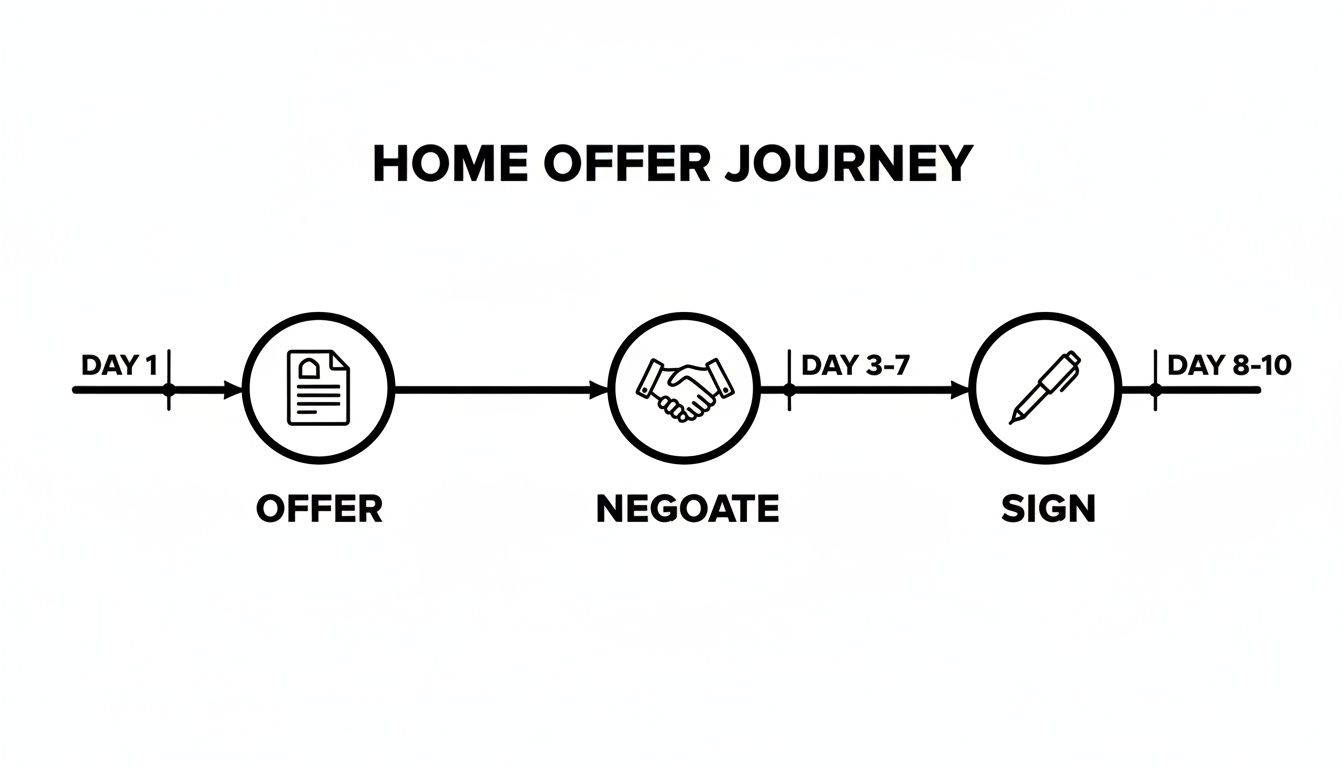
With the negotiation and signing behind you, it’s time to dive into the intensive due diligence steps that follow.
The All-Important Home Inspection
Your very first move after going under contract should be scheduling a home inspection. Seriously, don't wait on this. This is your chance to get a professional, unbiased look at the property’s true condition, far beyond what you can see during a showing. A good inspector is worth their weight in gold, so look for someone with strong local reviews and certifications.
If you can, absolutely attend the inspection. Following the inspector around and asking questions gives you a level of context that a written report just can't capture. They’ll point out the difference between minor cosmetic stuff and potential big-ticket problems with the roof, foundation, HVAC, or electrical systems.
You'll usually get the detailed report within 48 hours. Once you have it, you and your agent will decide how to move forward. If significant issues pop up, you generally have a few options:
- Ask the seller to make the repairs before closing.
- Request a credit from the seller to cover the future cost of repairs.
- Negotiate a lower sale price to compensate for the needed work.
Clearing the Appraisal and Securing Insurance
While you’re wrapped up in the physical inspection, your lender is busy doing its own due diligence. They’ll order a home appraisal to make sure the property is actually worth the price you’ve agreed to pay. An appraiser will visit the home and compare it to similar, recent sales in the area to determine its fair market value.
If the appraisal comes in low, it can create a financing gap. You’ll need to work with your agent to renegotiate with the seller, bring more cash to the table to cover the difference, or—if your contract allows—walk away from the deal entirely.
At the same time, you need to lock in homeowners insurance. Lenders won't fund your loan without proof of a paid policy, so start shopping for quotes early. Rates and coverage can vary dramatically between providers.
The Role of the Title Company
Behind the scenes, a title company is doing some of the most critical legal legwork. They conduct a thorough title search to verify the seller has the legal right to sell the property and to ensure there are no outstanding liens, claims, or debts attached to it.
A title company’s job is to ensure you receive "clear title," meaning the home is truly yours without any surprise ownership claims from previous owners or creditors popping up down the road. This is one of the most important but least understood parts of the homebuying process.
They'll issue title insurance policies for both you and your lender, which protects everyone from future disputes over ownership.
This table provides a bird's-eye view of a typical closing timeline, highlighting the key milestones and who's responsible for what after your offer is accepted.
Timeline From Accepted Offer to Closing Day
| Timeframe (After Offer Acceptance) | Key Milestone | Who Is Responsible? |
|---|---|---|
| Days 1-3 | Deposit Earnest Money | Buyer |
| Days 1-10 | Schedule & Complete Home Inspection | Buyer & Buyer's Agent |
| Days 10-20 | Home Appraisal Is Ordered & Completed | Lender |
| Days 10-25 | Secure Homeowners Insurance | Buyer |
| Days 15-30 | Final Loan Underwriting & Approval | Lender |
| 3+ Days Before Closing | Receive & Review Closing Disclosure (CD) | Lender & Buyer |
| 1-2 Days Before Closing | Final Walk-Through | Buyer & Buyer's Agent |
| Closing Day | Sign Documents & Transfer Funds | Buyer, Seller, Agents, & Title Co. |
Seeing the process laid out like this can help demystify what can feel like a complicated and lengthy waiting game.
Understanding Your Closing Disclosure
About three business days before your scheduled closing date, you'll receive a game-changing document: the Closing Disclosure (CD). This five-page form gives you the final, itemized breakdown of your loan terms and all the costs you'll be paying.
Review this document with a fine-tooth comb. Compare it line-by-line to the Loan Estimate you received when you first applied. Check for any differences in your interest rate, monthly payment, or the final cash-to-close amount. If anything looks off, call your lender immediately to get it sorted out.
Final Steps to Getting Your Keys
The day before or the morning of closing, you'll do a final walk-through of the property. This is your last chance to confirm the home is in the same condition as when you agreed to buy it and that any negotiated repairs have been completed.
On closing day, you’ll feel like you’re signing your life away (it’s a lot of paperwork!). You'll provide a certified or cashier's check for your down payment and closing costs, and then, you officially take ownership. Once the paperwork is done and the funds are transferred, you'll finally get the keys.
After the celebration, one of the first things you should do is secure your new home. Many new homeowners find peace of mind by rekeying door locks to ensure no old copies are floating around. This final step marks the true beginning of your life in your new home.
Got Questions? Let's Get Them Answered
Even when you follow a roadmap for buying a house, you’re bound to hit a few detours with questions you didn't see coming. It’s completely normal. Let’s tackle some of the most common things that pop into buyers' heads along the way.
How Much House Can I Really Afford?
This is the big one, isn't it? A lender might pre-approve you for a huge number, but that doesn't mean you should spend it all. The last thing you want is to be "house poor," where your mortgage payment eats up your entire budget.
A great guideline I always share with clients is the 28/36 rule. It’s simple:
- Your total monthly housing payment (that’s principal, interest, taxes, and insurance, or PITI) shouldn't be more than 28% of your gross monthly income.
- Your total monthly debt (housing plus car payments, student loans, credit cards) should stay below 36% of your gross income.
So, if your household brings in $7,000 a month before taxes, you should aim for a total housing payment under $1,960. This keeps you comfortable and gives you a much more realistic price range than any generic online calculator.
What's the Real Deal with Credit Scores?
There’s no single magic number here—the "right" score really depends on the loan you're trying to get. Think of it less as a pass/fail grade and more like a key that unlocks different doors.
Here’s a quick breakdown of what lenders are generally looking for:
- Conventional Loans: You'll typically need at least a 620. But if you want the best interest rates (and who doesn't?), you should be aiming for 740 or higher.
- FHA Loans: These are much more forgiving. You can often get approved with a score as low as 580, provided you have a 3.5% down payment.
- VA and USDA Loans: While the government programs themselves don't set a hard minimum, the lenders who issue these loans usually want to see a score in the 620-640 range.
Your credit score is essentially your financial report card. A higher score tells lenders you’re a reliable borrower, and they'll reward you with a lower interest rate. Over 30 years, that small difference can save you tens of thousands of dollars.
Is Waiving the Home Inspection Ever a Good Idea?
I get it. In a crazy-competitive market, you want your offer to stand out. Waiving the inspection seems like an easy way to do that. But honestly? It's one of the riskiest gambles you can take.
The home inspection is your one chance to peek behind the curtain and see what’s really going on with the property. You wouldn't buy a used car without popping the hood, right? This is the single biggest purchase of your life—it deserves the same level of scrutiny.
An inspector can spot things you’d never notice, like a looming foundation issue, an ancient electrical panel, or a leaky roof. These aren't small fixes; they can run into tens of thousands of dollars. Without an inspection, you're buying the house "as-is," problems and all. It’s a roll of the dice I never recommend.
What Happens If the Appraisal Comes in Low?
This can feel like a major roadblock, but it doesn't have to be a deal-breaker. This is exactly why we include an appraisal contingency in the offer. If the official appraisal comes in below the price you agreed to pay, your lender will only finance the lower, appraised value.
When that happens, you’ve got a few choices:
- Renegotiate: The most common first step. You go back to the seller and ask them to lower the price to match the appraisal.
- Pay the Difference: If you have the cash and love the house, you can cover the "appraisal gap" out of pocket.
- Meet in the Middle: Often, the buyer and seller agree to split the difference to keep the deal alive.
- Walk Away: Thanks to your appraisal contingency, you can cancel the contract and get your earnest money deposit back.
A low appraisal simply opens up a new round of negotiations. It's not the end of the world, but it is a critical moment in the process.
The path to owning a home has its twists and turns, and having an expert in your corner makes all the difference. At Mortgage Seven LLC, our job is to make the financing clear and simple, connecting you with the right loan for you. Whether this is your first home or your tenth, we're here to help you move forward with total confidence. Schedule your free consultation today!