A DSCR loan, which stands for Debt-Service Coverage Ratio, is a game-changer for real estate investors. It's a type of mortgage where the lender qualifies you based on the investment property's cash flow, not your personal income.
Think of it this way: the property is applying for its own loan. If it can prove it generates enough rental income to cover the mortgage payment and other expenses, you're in a great position to get approved. This means you can often skip the headache of providing personal tax returns or W-2s.
What Is a DSCR Loan and Who Is It For?
Let's say you've found the perfect rental property. The numbers work, and it's a cash-flow machine. But maybe you're self-employed with income that's hard to document, or you already have a few mortgages and are bumping up against conventional lending limits. A traditional bank might take one look at your personal debt-to-income ratio and say "no."
This is exactly where a DSCR loan shines. Instead of digging through your personal finances, the lender focuses on one crucial question: "Does this property make enough money to pay for itself?"
This unique approach makes it the perfect financing tool for a very specific type of buyer.
For a quick overview of what these loans entail, take a look at the summary below.
DSCR Loan at a Glance
| Feature | Description |
|---|---|
| Loan Type | Mortgage for non-owner-occupied investment properties. |
| Qualification Basis | Property's rental income and cash flow. |
| Income Verification | Personal income (W-2s, tax returns) is typically not required. |
| Ideal Borrower | Real estate investors, self-employed individuals, and portfolio builders. |
| Primary Goal | To finance properties based on their own investment potential. |
This table highlights why DSCR loans have become such a popular and powerful tool for investors.
The Ideal Candidate for a DSCR Loan
First things first: DSCR loans are strictly for non-owner-occupied investment properties. You can't use one to buy the house you plan to live in.
They are a fantastic fit for:
- Seasoned Real Estate Investors: If you're looking to scale your rental portfolio without hitting the conventional loan limit (typically 10 properties), DSCR loans are your best friend.
- Self-Employed Borrowers: For entrepreneurs, freelancers, and business owners, proving income can be a nightmare. DSCR loans bypass that completely by focusing on the property's income instead.
- Investors with Complex Finances: Have multiple income streams or significant assets? If you'd rather not untangle your entire financial life for a lender, this is a much simpler path.
- First-Time Investors: Even if you're new to the game, a DSCR loan can help you get started. As long as you have the down payment, the property's projected income can get you across the finish line.
Ultimately, if you've found a solid investment property that cash flows, a DSCR loan provides a direct route to financing it on its own merits. It's a powerful way to build wealth through real estate with fewer roadblocks.
Once you’ve closed the deal, the next step is managing your new asset effectively. Using some of the best property management apps can help you streamline operations and maximize your returns from day one.
Here at Mortgage Seven LLC, we specialize in helping investors in Fairfax and across the region secure these flexible and powerful loans.
How the Debt Service Coverage Ratio Is Calculated
The entire idea behind a DSCR loan boils down to a single, powerful number. While "Debt Service Coverage Ratio" might sound like Wall Street jargon, the concept is refreshingly simple. It answers one critical question: does this property make enough money to pay for itself?
The formula is the engine that drives the whole loan approval.
DSCR = Net Operating Income (NOI) / Total Annual Debt Service
Think of this calculation as the property's financial report card. It tells a lender, in plain black and white, whether your investment stands on its own two feet. A good grade means you're in a great position to get approved, often with better terms and without ever showing a personal pay stub.
Let's pull back the curtain on each part of this equation.
Breaking Down Net Operating Income (NOI)
The first half of the formula, Net Operating Income (NOI), is just a fancy way of saying "the property's annual profit before the mortgage is paid." It’s the cash the property generates after you’ve covered all the regular running costs.
Figuring out the NOI is a two-step process:
- Start with Gross Rental Income: This is the absolute maximum rent you could collect in a year if the property was occupied 100% of the time.
- Subtract Operating Expenses: This is where we get realistic. You'll deduct all the costs of keeping the lights on and the property in good shape.
Common operating expenses include things like:
- Property Taxes
- Homeowners Insurance
- HOA Dues
- Property Management Fees
- An allowance for Maintenance and Repairs
One key thing to remember is that the mortgage payment itself isn't included here—that comes later. To get your numbers right from the start, it's a good idea to understand how to calculate rental income accurately.
Understanding Total Annual Debt Service
The other piece of the puzzle is Total Annual Debt Service. Don't let the name intimidate you; it's just the total you'll pay for your mortgage over a full year.
You find this number by adding up your monthly PITI payment and multiplying by 12.
PITI stands for:
- Principal: The part of your payment that actually reduces your loan balance.
- Interest: The fee you pay the lender for borrowing the money.
- Taxes: Your monthly share of the property taxes.
- Insurance: Your monthly homeowner's insurance premium.
This figure represents the property's biggest financial responsibility. Once you have your NOI and your annual debt service, you have everything you need. If you want to play around with some numbers, you can use our mortgage payment calculators to see how different loan scenarios would affect your annual debt.
Putting It All Together: A Real-World Example
Let's walk through an example to see how this works in practice. Say you're looking at a rental property in Fairfax, Virginia.
- Gross Annual Rental Income: $36,000 ($3,000/month)
- Annual Operating Expenses (taxes, insurance, etc.): $6,000
- Total Annual Mortgage Payment (PITI): $24,000 ($2,000/month)
First, we find the NOI:
$36,000 (Gross Income) – $6,000 (Expenses) = $30,000 (NOI)
Now, we can calculate the DSCR:
$30,000 (NOI) / $24,000 (Debt Service) = 1.25 DSCR
A DSCR of 1.25 is solid. It means the property brings in 25% more income than it needs to cover the mortgage and expenses. That’s the kind of buffer lenders love to see. It shows them there’s room to handle an unexpected repair or a month of vacancy without missing a payment.
The process is really about seeing the property as its own business.
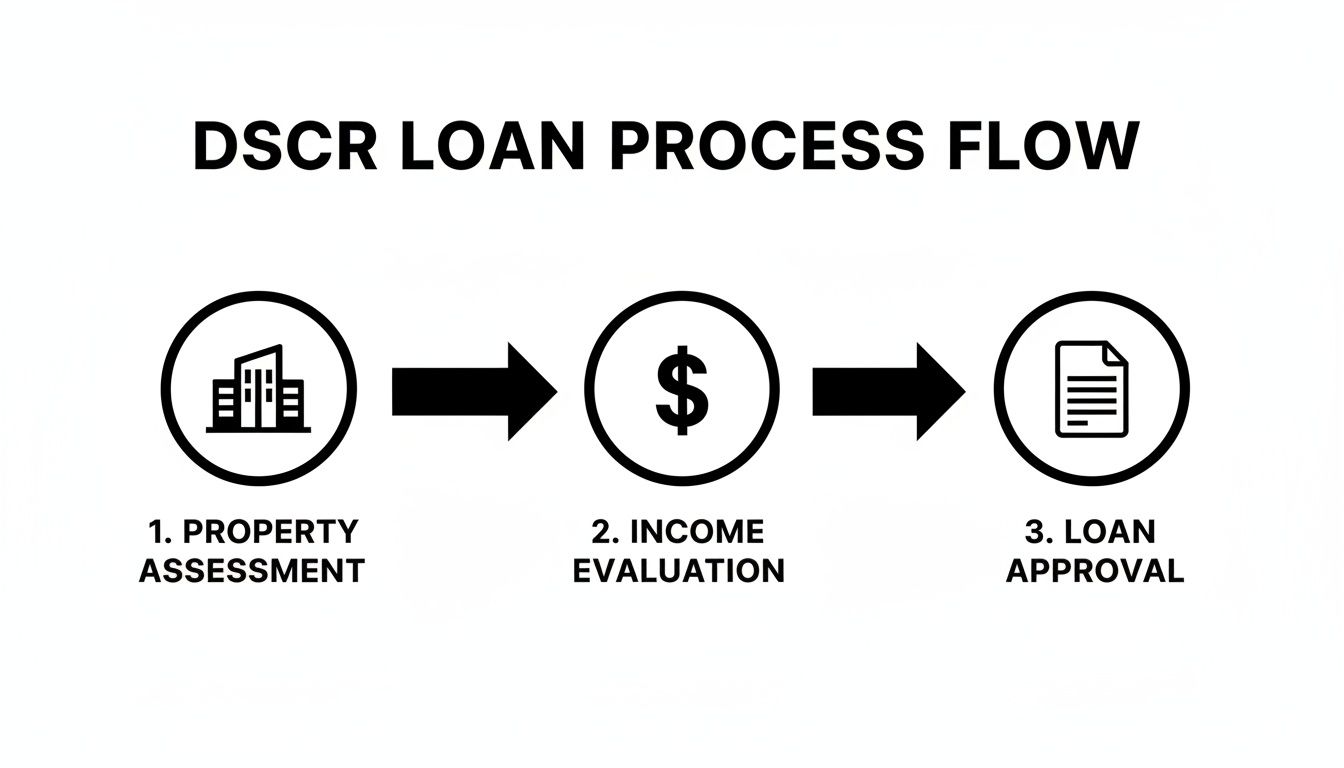
As you can see, the lender first assesses the property's income potential, then uses that to structure the loan. It's a business-first approach to real estate financing.
A DSCR of 1.0 is the absolute break-even point. Anything lower, and the property is technically losing money every month. That’s why most lenders look for a DSCR of at least 1.20 or 1.25—it proves the investment is not just surviving, but thriving.
DSCR Loans Versus Conventional Mortgages
Picking the right financing for an investment property is like choosing the right tool for a job. You wouldn't use a hammer to turn a screw, right? Similarly, while both DSCR loans and conventional mortgages can get you the keys to a rental, they work in fundamentally different ways. The best option for you really boils down to your personal financial situation and your overall investment strategy.
A conventional loan is the path most people are familiar with. It's all about you, the borrower. Lenders put your personal finances under a microscope, asking for tax returns, W-2s, and a detailed employment history to calculate your personal debt-to-income (DTI) ratio.
A DSCR loan, on the other hand, flips the focus from you to the property itself. It’s a business-minded approach where the investment's ability to generate cash flow is the star of the show. This core difference creates a whole new world of opportunities—and a few trade-offs—for real estate investors.
The Core Difference: Income Verification
The biggest single distinction between these two loans is how you qualify. A conventional loan essentially asks, "Can you afford this mortgage?" A DSCR loan asks a different question entirely: "Can the property afford this mortgage?"
With a conventional mortgage, your personal income is everything. Lenders need to see a steady, predictable income from your job or business to feel comfortable. If you're self-employed, a gig worker, or have income that fluctuates, this can turn into a major paperwork headache.
DSCR loans change the game. Your personal tax returns and pay stubs usually stay in the drawer. Instead, the lender zeroes in on the property's gross rental income and weighs it against the total housing payment (PITI). If the property makes enough money to cover its own bills and then some, you've cleared the main hurdle.
This approach is a lifesaver for investors who don't fit into the neat W-2 box. It lets the strength of your investment do the talking, prying open doors that conventional financing often keeps bolted shut.
For experienced investors, this means the quality of the deal you find is far more important than how your personal income is structured.
Speed, Scalability, and Flexibility
When you're trying to build a real estate portfolio, speed and scalability are your best friends. The rigid rules of conventional lending can often feel like trying to run in mud, creating bottlenecks that can cost you your next great deal.
Here’s how the two loan types stack up in the real world:
- Closing Speed: DSCR loans almost always close faster. Why? Less paperwork. By cutting out the need to verify personal income, the underwriting process is much more straightforward. This can give you a huge advantage in a competitive market where sellers want a quick, clean closing.
- Portfolio Growth: This is a big one. Conventional lenders typically hit the brakes after you've financed 10 properties. DSCR lenders? They generally have no such limits. This lets you scale your portfolio as big as you can find profitable deals.
- Borrower Type: Looking to buy property in an LLC for liability protection? A DSCR loan is perfect for that. This separates your personal assets from your business investments—a structure that can get complicated or even blocked when using conventional financing.
This kind of flexibility makes DSCR loans the go-to tool for serious investors who are focused on building wealth for the long haul. It treats your real estate hustle like the business it is.
Head-to-Head Comparison
To really make the choice clear, let's put these two loan types side-by-side. The table below lays out the key differences, helping you see exactly where each one shines so you can match your financing to your goals.
Comparing DSCR Loans and Conventional Investment Loans
| Feature | DSCR Loan | Conventional Loan |
|---|---|---|
| Primary Qualification | Property's cash flow (DSCR) | Borrower's personal DTI |
| Income Documents | Lease agreements, rent schedules | W-2s, tax returns, pay stubs |
| Closing Speed | Typically faster due to less paperwork | Can be slower due to extensive documentation |
| Number of Properties | No limit, ideal for scaling | Often capped at 10 financed properties |
| Best For | Self-employed, portfolio builders | W-2 employees, first-time investors |
While a conventional loan might occasionally offer a slightly lower interest rate, you're trading that for a rigid process that isn't always built for the fast-paced world of real estate investing.
For investors who need speed, flexibility, and a clear path to growth, understanding what a DSCR loan is and how it operates is the first crucial step toward building a powerful and scalable rental portfolio.
Who Qualifies and What Documents Are Needed
So, what does it actually take to get a DSCR loan? It’s one thing to understand the concept, but another to know if you can actually qualify. The great news is that the entire process is designed for real estate investors, so it’s often much more straightforward than getting a conventional mortgage.
The focus completely shifts from your personal income to the property's ability to generate income. It’s a business-like approach for a business investment.
First thing’s first: DSCR loans are strictly for non-owner-occupied properties. You can use them to finance single-family rentals, 2-4 unit multi-family buildings, and in some cases, condos and townhomes. You absolutely cannot use this type of loan to buy the home you plan to live in. The property must be a legitimate investment.
Beyond that main rule, lenders will look at a few other things to get comfortable with the deal.
Key Borrower Requirements
Even though your tax returns are off the table, lenders still need to know you’re a responsible borrower who can manage an investment property. Your personal financial health still matters, just not in the way you might be used to.
Here’s what most lenders will want to see:
- A Minimum Credit Score: The floor for a FICO score is usually around 620, but this can vary. A higher score will almost always get you a better interest rate and more flexible terms.
- A Solid Down Payment: Plan on putting down at least 20-25% of the purchase price. Bringing more cash to the table lowers the lender's risk and strengthens your negotiating position.
- Cash Reserves: Lenders want proof you can handle a few bumps in the road. You’ll need to show you have enough cash on hand to cover several months of mortgage payments (including principal, interest, taxes, and insurance) after closing.
The core idea is simple: the property pays the bills, but you need to be a financially stable captain steering the ship. This combination of a strong property and a responsible investor is what makes a DSCR loan work.
The Streamlined Document Checklist
This is where the magic really happens. Forget about digging up years of W-2s and tax returns. The document list for a DSCR loan is short, sweet, and focused entirely on the asset. This is why investors love them—they're just faster.
Typically, here's all you'll need to provide:
- Lease Agreement: If the property is already rented, this is your proof of income.
- Rental Appraisal (Form 1007): If the property is vacant or a new purchase, an appraiser will produce a report estimating its fair market rent. The lender will use this number for the DSCR calculation.
- Bank Statements: This is simply to verify you have the money for your down payment and the required cash reserves.
- Property Details: This includes the purchase contract and proof of homeowners insurance.
This straightforward approach has made DSCR loans one of the fastest-growing products in the mortgage world, especially as investor demand has surged. It’s easy to see why. If a property brings in $5,000 in monthly rent and the total monthly payment (PITI+HOA) is $4,000, that’s a 1.25 DSCR. The loan gets approved based on that simple math—no personal income needed. You can read more about this trend on National Mortgage Professional.
For self-employed investors, not having to show tax returns can be a game-changer. If you’re a business owner, you might also be interested in a profit and loss statement loan, which is another powerful tool that avoids traditional income verification. Once you understand what a DSCR loan is and how simple the paperwork is, you’ll see it’s a clear path to growing your real estate portfolio.
What to Expect for DSCR Loan Rates and Lender Requirements
When you're trying to figure out the numbers on a DSCR loan, the most important thing to remember is this: it's all about the property. Unlike a conventional mortgage where your personal W-2 income is front and center, with a DSCR loan, the lender is laser-focused on the investment property's ability to pay for itself.
Think of it this way: the stronger the property's financial performance, the more confident a lender feels. That confidence translates directly into better loan terms for you.
The Key Factors That Shape Your Loan Terms
The interest rate on a DSCR loan isn't some arbitrary number. It’s a direct reflection of the risk a lender sees in the deal, and they measure that risk using a few core metrics.
- Your DSCR: This is the big one. A higher ratio is king. A property with a DSCR of 1.50 (meaning it generates 50% more income than its expenses) is a much safer bet for a lender than one barely breaking even at 1.10. That strength almost always earns you a better rate.
- Loan-to-Value (LTV): This is just the loan amount versus the property's appraised value. The more skin you have in the game (a larger down payment), the lower the LTV. A lower LTV reduces the lender's risk and is often rewarded with a lower interest rate.
- Credit Score: While your personal income isn't part of the equation, your financial habits still matter. A strong FICO score is proof of your reliability and can open the door to more competitive pricing.
- Property Type: Lenders look at different types of properties—like a single-family home versus a four-plex—with different risk profiles. The type of asset you're buying can nudge the terms one way or another.
The market for these loans is surprisingly active. For example, back in May 2025, even with a slight uptick in interest rates, 80% of DSCR deals still closed with rates between 7.00% and 8.99%. Lenders were also comfortable offering up to 80% LTV on properties that showed solid performance. You can dig deeper into these market trends and DSCR momentum to get a feel for the current environment.
Key Takeaway: A strong property with a high DSCR and a solid down payment puts you in the driver's seat. It gives you the leverage to negotiate for the best possible terms.
Common Loan Structures and Smart Strategies
DSCR loans aren't one-size-fits-all. They come in different flavors to suit different investment goals. The most popular by far is the 30-year fixed-rate mortgage. It’s the go-to for buy-and-hold investors because it offers predictable monthly payments and long-term stability. No surprises.
But for investors looking to maximize cash flow right now, an interest-only (IO) loan can be a powerful tool. For a set period, often the first 10 years, you only pay the interest on the loan. This drops your monthly payment significantly, which in turn juices your cash flow and inflates your DSCR. It's a great strategy if your plan is to sell or refinance after a few years of appreciation.
The right structure really boils down to your specific goals. At Mortgage Seven LLC, we help you weigh these options to find a program that clicks with your investment plan. As a type of Non-QM loan, DSCR financing provides a kind of flexibility you just won't find in the conventional mortgage world. That's why working with a knowledgeable broker is so important—we can connect you with lenders whose programs are built for what you’re trying to accomplish with your portfolio.
Your Step-by-Step Guide to Applying for a DSCR Loan

So, you understand what a DSCR loan is and how it can help you finance your next investment property. But what does getting one actually look like in practice? The good news is the process is refreshingly straightforward, zeroing in on the property's income potential instead of your personal W-2s and tax returns.
Having a clear roadmap makes all the difference, turning a potentially confusing process into a predictable one. At Mortgage Seven LLC, we’ve broken it down into five simple stages to get you from application to closing table without the usual headaches.
Stage 1: The Initial Consultation
It all starts with a conversation. Before you even think about paperwork, we'll talk about your investment goals. Are you a seasoned pro looking to add a tenth property to your portfolio, or is this your very first rental? This chat helps us make sure a DSCR loan is genuinely the best fit for you and your specific deal. It’s about getting on the same page from day one.
Stage 2: Property Analysis
Next, we get down to the numbers that really matter for this type of loan. You’ll give us the details on the property you’re eyeing, and we’ll run a full analysis to calculate its potential DSCR. We look at the projected rental income and weigh it against the estimated principal, interest, taxes, and insurance (PITI).
This is a critical checkpoint. It confirms the property can financially stand on its own two feet before you invest any more time or money. Simply put, we answer the most important question: will this property pay for itself?
Focusing on the property’s cash flow this early lets us quickly spot a winning investment and steer clear of deals that just don't have the numbers to qualify for a DSCR loan.
Stage 3: Document Submission
Once we've confirmed the property's numbers work, it's time to gather the necessary documents. This is where you'll really appreciate the simplicity of a DSCR loan. No more hunting for two years of complicated tax returns.
Typically, the checklist is much shorter and includes things like:
- The signed purchase agreement for the property.
- Bank statements showing you have the funds for the down payment and any required cash reserves.
- A copy of the current lease agreement if there's already a tenant.
- Your LLC or corporate entity documents if you're buying under a business name.
This streamlined list helps keep things moving along quickly.
Stage 4: Lender Matching and Underwriting
With a complete file in hand, we tap into our network of lenders to find the one whose programs are the perfect match for your deal. We know which lenders prefer certain property types or have more flexible guidelines, so we can connect you with the right one. From there, their underwriting team does a final review to issue an official loan approval.
Stage 5: Closing Your Loan
This is the final stretch. After underwriting gives the green light and all conditions are cleared, you’ll sign the final loan documents. The funds are then transferred, and just like that, you’re the owner of a new income-producing property.
This five-step process takes the mystery out of securing a DSCR loan. Ready to take the first step? Schedule a consultation with the experts at Mortgage Seven LLC today and let's get you pre-approved for your next investment.
Frequently Asked Questions About DSCR Loans
Even after getting the basics down, you probably still have a few questions rolling around in your head. That's completely normal. Let's tackle some of the most common things investors ask so you can move forward with confidence.
Can I Use a DSCR Loan for My First Investment Property?
Yes, you absolutely can. In fact, many lenders have programs designed specifically for first-time real estate investors. The requirements might be a little tighter—maybe a higher credit score or a bigger down payment—but it’s a perfectly viable way to get your foot in the door.
The real star of the show is the property's ability to generate cash flow. Lenders will order a professional rental appraisal (you'll see it called a Form 1007) to verify the income potential. This is what makes DSCR loans such a great entry point for new investors who have the down payment but maybe not the W-2 income to qualify for a conventional loan.
Are DSCR Loans Available for Short-Term Rentals Like Airbnb?
Definitely. DSCR loans have exploded in popularity for financing short-term rentals (STRs). The process looks a little different because instead of a long-term lease, lenders project annual income using data from services like AirDNA.
While the core DSCR calculation is the same, the income verification is adapted for the STR model. It’s crucial to work with a mortgage broker who knows the ins and outs of STR financing to make sure everything goes smoothly.
Key Insight: The beauty of DSCR loans is their flexibility. As long as the income can be reliably projected, financing for properties like an Airbnb is completely on the table, opening up a whole new world of investment strategies.
What Happens If My Property's DSCR Is Below 1.0?
A DSCR below 1.0 is a deal-breaker for most lenders. It’s a clear signal that the property isn't pulling in enough rent to cover its own expenses, meaning it's starting out with negative cash flow.
Now, there are some niche lenders who offer "no ratio" or "no cash flow" DSCR programs for these situations. Be prepared, though—these loans come with much higher rates and require hefty down payments, often in the 30-40% range, to offset their risk. Honestly, a low DSCR should be a sign to pause and seriously ask yourself if this particular property is the right investment.
Is It Possible to Refinance with a DSCR Loan?
Yes, and it’s one of the most powerful ways to use them, especially for a cash-out refinance. This strategy is the backbone of the BRRRR (Buy, Rehab, Rent, Refinance, Repeat) method that so many investors swear by.
You can use a DSCR loan to pull equity from a property that's performing well and use that cash to fund your next deal. Because the approval is based entirely on the property's rental income and current value, you can scale your portfolio without ever touching your personal tax returns. It's the go-to tool for growing your real estate empire efficiently.
Figuring out the world of investment financing can feel overwhelming, but you don't have to go it alone. The team at Mortgage Seven LLC lives and breathes DSCR loans. We're here to help you find the perfect financing for your next property. Contact us today to get started!